

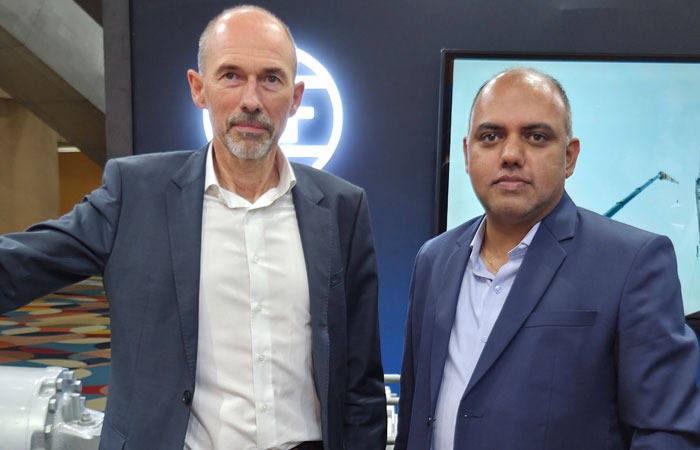
India has a cost advantage compared to many other regions
- Hermann Maier, Director, Industrial Technology, ZF Group
- Kishore Vishwanath Pissey, Head of R&D and Engineering Services, IA - Region India, ZF Group
What are the key products ZF is showcasing at Excon 2025, and how do they support OEM efficiency and uptime?
Hermann Maier (HM): Our primary focus at Excon is on drive axles for construction machinery applications such as backhoe loaders, wheel loaders and similar equipment. These are state-of-the-art products developed within ZF’s global technology framework. What is significant this year is that these products are now being produced from our new manufacturing footprint in Coimbatore, making them available not only for the Indian market but also for Asia and South America.
ZF has long been recognised as a technology leader in construction machinery drivetrains. These products stand out for their efficiency and durability, but equally for their consistent quality. For OEMs, this translates into higher uptime, predictable performance and lower lifecycle costs.
What are ZF’s current priorities in terms of engineering and manufacturing expansion in India?
Kishore Vishwanath Pissey (KVP): With India becoming increasingly central to ZF’s global strategy, we have expanded our footprint significantly. We have added around 10,000 sq ft of new manufacturing space in Coimbatore, where we are localising and assembling construction machinery transmissions and axles for both domestic use and export markets. We have also planned capacity headroom for future expansion as volumes scale.
How does this expansion support OEMs operating in India?
KVP: Local engineering and manufacturing enable faster response times, better application support and improved availability. For OEMs, this reduces dependency on long supply chains and supports faster product development cycles aligned with Indian operating conditions.
What is the current level of localisation, and how is it evolving?
HM: Localisation is a phased process. We begin with a significant proportion of locally sourced components to justify assembly and production in India. Over time, we progressively increase local content to improve cost competitiveness and availability. This approach also strengthens supply-chain resilience, which has become critical given recent geopolitical disruptions and material shortages.
Beyond construction machinery, which sectors are driving demand for these products?
HM: While construction machinery remains the primary market, these driveline solutions are also used in mining, underground mining and material handling applications. The versatility of the platform allows us to address multiple heavy-duty segments with similar performance expectations.
How do you assess the outlook for India’s component manufacturing sector?
HM: India has a clear cost advantage compared to many other regions. Leveraging this advantage is essential for global competitiveness. For ZF, India is not just a local market but a strategic base to support global growth through cost-effective, high-quality component manufacturing.
 A-303, Navbharat
Estates,
Zakaria Bunder Road,
Sewri (West), Mumbai - 400 015,
Maharashtra, India
A-303, Navbharat
Estates,
Zakaria Bunder Road,
Sewri (West), Mumbai - 400 015,
Maharashtra, India +91-22-24193000
 Subscriber@ASAPPinfoGlobal.com