
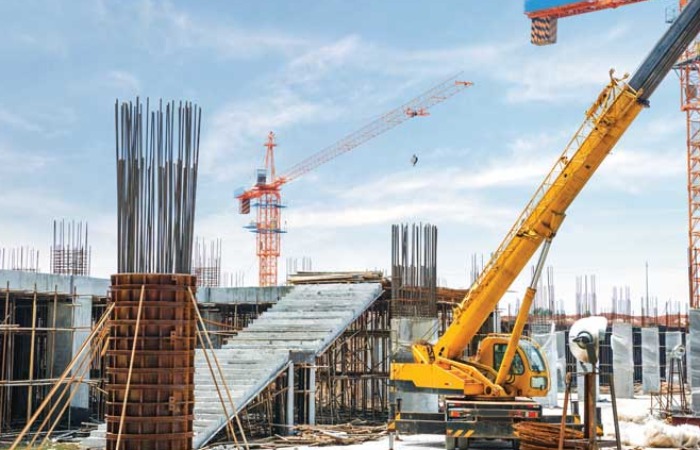
Air Apparent
From drilling to finishing, compressors are the silent drivers of construction, enabling faster, cleaner, and more efficient project execution.
India’s construction and infrastructure sector is expanding at an unprecedented pace, driven by massive public investments, urbanisation, and the push for industrial self-reliance. At the heart of this growth lies an often-overlooked but indispensable technology—compressed air. From powering pneumatic tools and drilling rigs to supporting sandblasting and concrete spraying, compressors are the silent enablers of modern construction sites.
Today, the compressor market is undergoing a transformation, shaped by sustainability mandates, digitalisation, localisation, and the need for higher efficiency. As project timelines shrink and environmental scrutiny rises, equipment manufacturers are innovating rapidly to deliver smarter, cleaner, and more reliable compressed air solutions.
Backbone of construction productivity
Compressed air remains fundamental to construction operations, particularly in remote and challenging environments where electrical alternatives may not be viable. Portable compressors, in particular, have emerged as critical assets for infrastructure development—from highways and metros to mining and tunnelling projects.
Prasanna Kulkarni, General Manager – Power Technique Customer Center, Atlas Copco (India), noted, “The XAS 58 and XAS 78 are developed to meet the challenges of the job site while ensuring portability, robustness, and fuel economy with consistent performance. These portable compressors allow our customers to go anywhere and work everywhere, maximising their working hours with easy control of operating costs.”
This emphasis on portability and ruggedness reflects the evolving nature of construction sites, which are increasingly fragmented, space-constrained, and geographically dispersed. Equipment that can be easily transported and quickly deployed offers a clear advantage.
Efficiency and sustainability take centre stage
With India committing to reduce carbon intensity by 45 per cent by 2030 and achieve net-zero emissions by 2070, sustainability has become a defining factor in equipment selection. Compressors, traditionally energy-intensive, are now being redesigned with efficiency and environmental impact in mind.
Manufacturers are also exploring alternative technologies to reduce lifecycle emissions. A notable development is the introduction of plant-based lubricants for compressors. These innovations reduce CO? emissions not just during operation but across the entire lifecycle—from manufacturing to disposal—marking a significant step towards greener industrial practices.
Digitalisation and smart monitoring
The compressor industry is increasingly embracing digital technologies to improve performance, reliability, and lifecycle value. Smart compressors equipped with sensors, IoT connectivity, and AI-driven analytics are enabling predictive maintenance and real-time monitoring.
Sunil Khanduja, Managing Director, Ingersoll Rand India and SAARC, emphasised the role of digitalisation: “Technology is reshaping every aspect of industry. Our EcoPlant solution enables customers to monitor, control, and optimise their entire compressed air system digitally, ensuring both efficiency and reliability.”
Khanduja further explained how digital tools are helping customers maximise asset utilisation: “Instead of investing in new machinery, industries can extend the life and value of their existing assets through solutions like CARE service, airend upgrades, retrofits, and variable frequency drive add-ons.”
This shift from product-centric to solution-centric offerings is redefining the value proposition of compressors. Customers are no longer just buying equipment—they are investing in performance, uptime, and long-term efficiency.
Rise of oil-free and clean air solutions
As construction projects increasingly intersect with sensitive environments—such as urban redevelopment, underground infrastructure, and industrial facilities—the demand for clean, oil-free compressed air is rising.
Ingersoll Rand has been actively expanding its oil-free portfolio to meet this demand. As Sampath Shetty, Business Director, Ingersoll Rand India, stated, “We are seeing growing demand for oil-free compressed air solutions from industries where air purity is critical. Our focus is on delivering high-performance, energy-efficient systems aligned with these requirements.”
Oil-free compressors not only improve environmental performance but also reduce the risk of contamination, making them suitable for specialised applications within construction and allied industries.
Localisation and ‘Make in India’ push
Local manufacturing is playing a pivotal role in shaping the compressor market in India. With the government’s emphasis on ‘Make in India’, manufacturers are strengthening their domestic production capabilities to enhance responsiveness, reduce costs, and support exports.
Khanduja highlighted India’s strategic importance: “India today is one of the most promising manufacturing destinations in the world. We are witnessing increasing confidence in India’s ability to serve both domestic and global demand.”
Localisation not only ensures faster delivery and service but also enables manufacturers to tailor products to the specific needs of Indian construction environments, which often involve extreme conditions and diverse applications.
Expanding role of rentals
The growing complexity and cost of construction equipment have led to the rapid expansion of the rental ecosystem. Compressors, especially portable units, are increasingly being deployed through rental fleets, allowing contractors to access high-quality equipment without significant capital investment.
Ingersoll Rand is also strengthening its service-led business model, focusing on lifecycle value through service contracts, digital integration, and enhanced support networks.
Emerging opportunities in clean energy
Beyond traditional construction applications, compressors are finding new roles in clean energy infrastructure, particularly in LNG, CNG, and hydrogen systems. The integration of compressors into gas distribution and storage systems is opening up new growth avenues.
The acquisition of Tulip Compression by TIL Limited underscores this trend. The move expands capabilities in hydrogen compression systems, LNG storage, and gas processing, aligning with India’s broader energy transition goals.
As Raj Kumar Sachdeva, CEO, Tulip Compression, noted, the collaboration is expected to “accelerate product development and reinforce quality standards, positioning the combined entity to lead in hydrogen compression and LNG solutions.” This convergence of construction, energy, and industrial applications is likely to redefine the compressor market in the coming years.
Urban infrastructure projects, particularly in Tier II and III cities, are driving demand for compact and mid-sized compressors. These machines are designed to operate in space-constrained environments while maintaining high efficiency and low emissions.
Road ahead
The future of compressors in the construction industry will be shaped by four key trends—sustainability, digitalisation, localisation, and diversification into new applications. As Khanduja aptly summed up, “We see ourselves not just as manufacturers, but as partners in building a more sustainable industrial future for India.”
 A-303, Navbharat
Estates,
Zakaria Bunder Road,
Sewri (West), Mumbai - 400 015,
Maharashtra, India
A-303, Navbharat
Estates,
Zakaria Bunder Road,
Sewri (West), Mumbai - 400 015,
Maharashtra, India +91-22-24193000
 Subscriber@ASAPPinfoGlobal.com