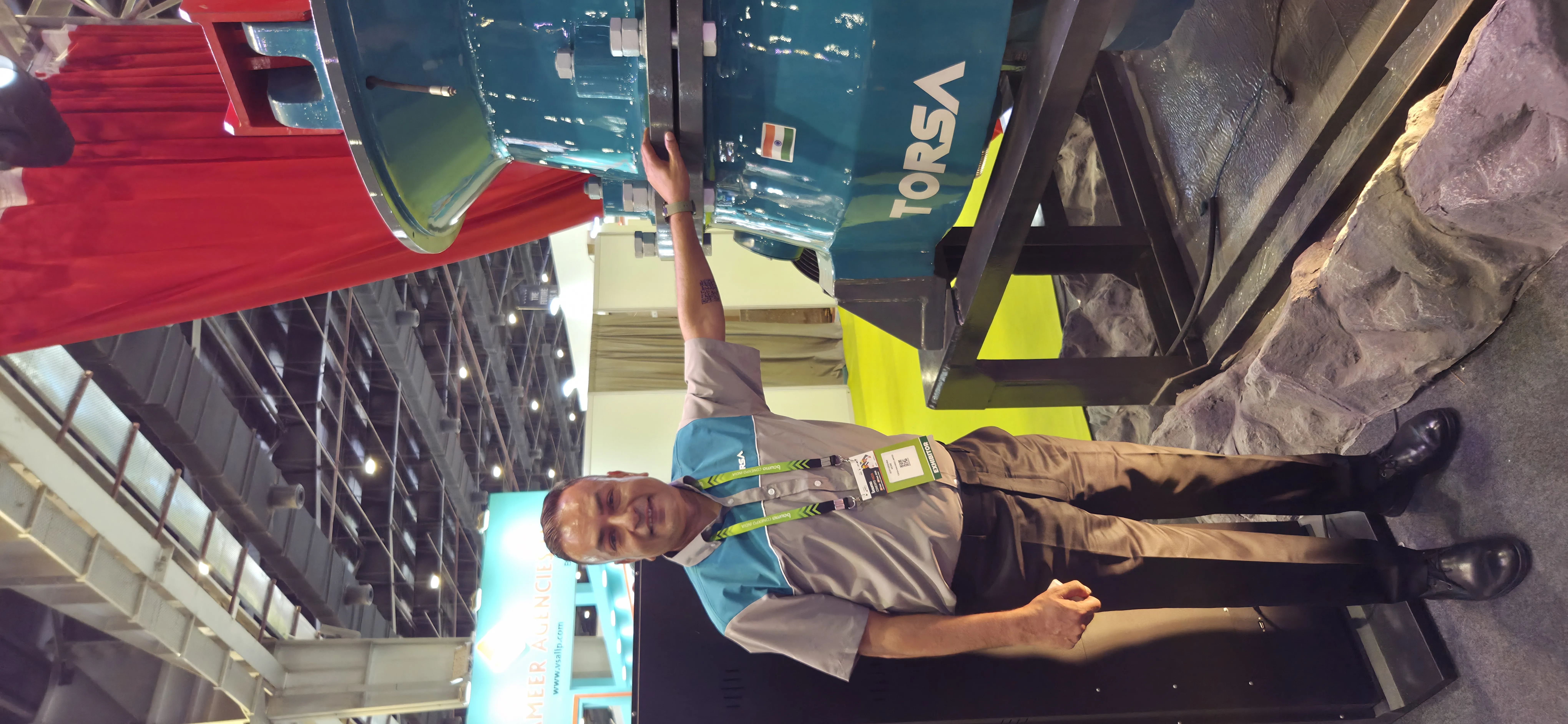
“If you don’t measure, there is no sustainability report.”
An Exclusive Interview with Gopi Krishna More, Managing Director, TORSA Machines
What are the key products TORSA is showcasing at bauma ConExpo 2026?
We are showcasing five new-generation products covering crushing, shaping and sand processing. These include the TEC 10 secondary cone crusher, the TSH 10 sander cone crusher, the larger TEC 11 cone crusher, the VORTEX vertical shaft impactor and the EcoCycle sand-washing plant. The TEC 11 can handle up to 300 tph in a single line.
The significance of this portfolio is that we can now address a much larger part of the material-processing cycle. Depending on the requirement, customers can process raw material into aggregates, gravel, manufactured sand and plaster sand through an integrated solution. For higher capacities, multiple lines can also be engineered together.
Our broader portfolio additionally includes jaw crushers, dry and wet screening equipment, feeders and compact plants.
How important is indigenous technology and localisation to TORSA?
Localisation is central to what we are building. The new-generation machines showcased here are based on indigenous technology, and our objective has been to develop the capability to manufacture and engineer these solutions in India.
Over the years, we have worked with international companies, entered joint ventures and imported technologies. That experience helped us understand different approaches, but we have gradually built our own engineering capabilities.
It has taken many years of development, learning and investment to reach this stage. The emphasis now is on strengthening indigenous technology while expanding into higher-value crushing, shaping, washing and material-processing solutions.
How are automation and IoT changing crushing and material-processing plants?
Sustainability has to start with measurement. If you don’t measure what a plant is consuming or producing, it becomes difficult to evaluate its environmental or operational performance.
Our plants can be enabled with IoT so that an owner sitting at a desktop can monitor parameters such as diesel consumption, material throughput and production across different parts of the plant.
At the same time, technology has to suit operating realities. If a machine becomes excessively complex, customers operating in remote locations may not always have the technical manpower available to diagnose and rectify issues immediately. So while we offer advanced monitoring and automation, I also believe strongly in keeping machines practical and straightforward to operate and maintain.
TORSA uses the positioning ‘Built for Every Terrain’. What has shaped that engineering philosophy?
Our roots in the Northeast have played an important role. The region presents very different operating conditions compared with many other parts of India. Equipment can encounter heavy rainfall, water seepage, difficult terrain, temperature variations and challenging maintenance conditions.
Over the years, we have also installed machines in high-altitude locations and extremely dusty environments where even lubricants and machine components can be affected by operating conditions.
We have had failures along the way, and we have learned from them. Today, when we approach an application, we look at the customer’s mineral, location and environmental conditions before deciding how the equipment should be configured. Even something as basic as the grease specification can change for sub-zero operating conditions.
Those experiences have shaped our approach to building equipment for varied terrain and also give us confidence when considering international markets.
Where do you see the next major growth opportunity within India?
I believe the Northeast can become an important engine of India’s next phase of growth. The region has its own geographical and infrastructure challenges, but investment is increasing.
Because TORSA has grown out of this region, we understand many of these operating challenges. At the same time, our presence has expanded well beyond the Northeast. We now have a wider national footprint, with manufacturing operations in Kolkata and Guwahati and more than 2,500 installations across India and neighbouring countries.
The opportunity ahead is to deepen our presence across India while progressively developing selected international markets.
How are you approaching employee and technician skilling as the equipment becomes more sophisticated?
Skilling does not necessarily require creating everything internally. There are established institutions and companies that already provide specialised training.
What is important is enabling employees to access those programmes and giving them both the budget and the time required for training. If better welding, finishing or manufacturing practices are available, we should allow our people to learn them and bring those capabilities back into the organisation.
Ultimately, the objective is consistent product quality. We want the machine delivered today to continue performing and retaining its quality several years later.
How is TORSA's approach to crushing efficiency and sustainability evolving?
Earlier, much of the industry's attention was simply on crushing material and maximising output. The conversation is now changing towards the cost per tonne.
We need to examine how to minimise the cost per tonne while remaining sustainable and profitable and using resources efficiently over a longer period. That requires improvements across technology, equipment efficiency, application engineering and lifecycle support.
What is TORSA's growth roadmap over the next five years?
We have set ourselves an ambitious goal of building TORSA into an Rs 500-crore business over the next five years. The objective is not simply to become a larger version of the company we are today; reaching that scale will require us to develop new technologies, enter additional applications and markets, strengthen manufacturing and build deeper relationships with customers throughout the equipment lifecycle.
Our roadmap therefore covers five broad areas: indigenous technology and higher-value material-processing solutions; moving from individual machines towards integrated solutions; expanding our domestic and selected international presence; strengthening spares, service, upgrades and lifecycle support; and investing in manufacturing capabilities, processes, talent and leadership.
The larger transition is from being viewed primarily as a crushing and screening equipment manufacturer towards becoming a material-processing technology and lifecycle-solutions company.
 A-303, Navbharat
Estates,
Zakaria Bunder Road,
Sewri (West), Mumbai - 400 015,
Maharashtra, India
A-303, Navbharat
Estates,
Zakaria Bunder Road,
Sewri (West), Mumbai - 400 015,
Maharashtra, India +91-22-24193000
 Subscriber@ASAPPinfoGlobal.com