Beyond Deployment: Managing Regulatory Risks in IEs
Businesses dealing with the supplies of industrial and construction equipment (such as aerial work platforms (AWPs), mobile elevating work platforms (MEWPs), cherry pickers) often place emphasis only on commercial terms of supply, unit economics, and asset monetisation. While these are critical, there are material legal and regulatory risks which frequently arise post deployment (whether on lease/hire or sale) in terms of how the products are used, supported and branded, which may become stumbling blocks for businesses looking to scale or go public.
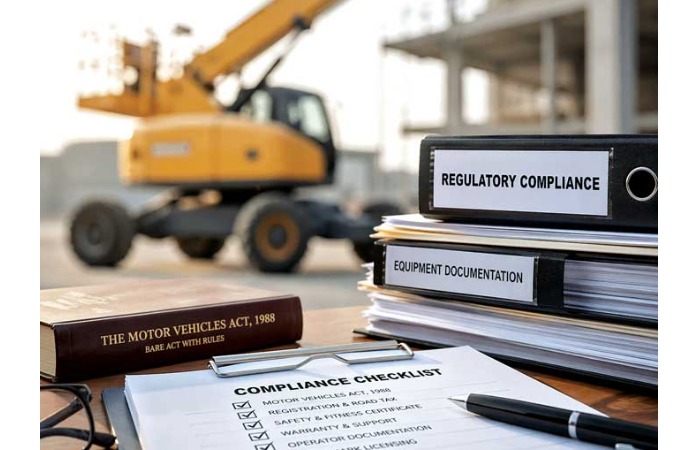
Motor vehicles: To be or not to be: A question of law that has been particularly troublesome is whether the equipment “ AWPs, MEWPs, cranes, etc. are considered as motor vehicles under the Motor Vehicles Act, 1988 (MVA). The definition of motor vehicles under the MVA is extensive and includes any mechanically propelled vehicle adapted for use upon roads but excludes a vehicle of a special type adapted for use only in a factory or in any other enclosed premises.
If categorised as motor vehicles, these equipment would have to be registered with the Regional Transport Office, and be subject to technical evaluation for safety and fitness, and also be subject to state-specific road taxes “ similar to commercial vehicles, such as trucks and buses. Failure to comply may result in accumulation of road taxes and registration fees, including by seizure of the equipment.
For AWPs, MEWPs, etc. operating primarily within construction sites, airports, factory, warehouses, etc., users/suppliers contend that the equipment are operating only within a factory or an enclosed space, thereby keeping it outside the purview of MVA. On the other hand, authorities have taken punitive measures (including seizures) for equipment such as boom lifts, fork lifts, vertical lifts, etc., on the ground that these mechanically propelled vehicle adapted for use upon roads and that the exclusion would not apply since the equipment (though not used) could be used on roads. These conflicting positions led to uncertainty and substantial litigation “ particularly regarding the levy of state-specific road tax laws.
In this respect, the Supreme Courts in Ultratech Cement Limited v. State of Gujarat (2026) introduced a use-based test, i.e., any equipment being deployed exclusively for enclosed industrial premises is outside the scope of the definition of a motor vehicle. This marked a key departure from previous rulings (including the Supreme Courts earlier ruling in Bolani Ores v. State of Orissa (1974)) which followed a functionality test, i.e., any equipment capable of use on public roads would be considered a motor vehicle. While legal ambiguity still abounds, particularly in light of the high court rulings on different set of facts, legislations, etc., the Ultratech ruling provides much needed guidance on the risk mitigants businesses can adopt.
Operators and suppliers should ensure appropriate protections for these in usage and documentation, especially considering improper usage by a single user may have wider ramifications for the supplier.
Warranty arrangements: A number of equipment deployed in India, while rented from domestic operators, are imported. Warranties, customer support, and post-sale services is a key challenge for the operators domestically “ for example, warranties on functionality, maintenance procedures, availability of spare parts, etc. rely heavily on cooperation by the offshore OEMs.
Accordingly, Indian importers should identify and build a risk-allocation mechanism to minimise exposure. They should enter into agreements with the OEMs, clearly setting out the warranties from the OEMs, together with corresponding indemnity protections. Such agreements should further incorporate back-to-back arrangements to ensure that any warranty commitments extended by the Indian importer/distributor to the end user are fully supported by equivalent obligations from the OEM, thereby mitigating the risk of any gap in coverage.
While the issue may not seem very critical on a stand-alone basis for Indian distributors/ operators, they leave the party exposed to legal risk, which becomes a point of negotiations in any potential monetisation.
Usage of common trademarks: Where multiple entities within a group use a common trademark or wordmark due to the well-known nature of such mark, such usage should be formalised through intra-group arrangements. While overlooked on the basis that they are intra-group in nature, lack of documentation results in group entities (other than the registered proprietor) lacking a legal right to use the marks, giving rise to issues in diligence or regulatory scrutiny, including challenges to the use of the marks when provided to third parties.
Formal documentation clarifying that the legal owner grants a license to other group entities, clearly setting out the scope of use, basic quality control requirements, and the fact that ownership remains with the licensor; helps ensure clarity on permitted use and mitigates such risks.
From an accounting and tax perspective, the pricing should be on a documented arms length basis to comply with transfer pricing requirements. In addition, it is useful to include simple brand usage guidelines to ensure consistency in how the mark is used across entities. A basic framework for handling third-party infringement may also be included so that enforcement is coordinated and controlled by the trademark owner.
From a practical perspective, creating distinct brands within the groups or otherwise demarcating brand usage guidelines “ including development of sub-brands linked to lines-of-business, such as rentals or sales, or product-linked, such as AWPs, MEWPs, etc. may also help in the long-term to provide better opportunities for asset/brand monetisation, even if undertaken on a division-basis only.
Businesses ought to have a holistic approach in their contractual arrangements around the procurement, operation and usage of industrial equipment through appropriate safeguards.
ABOUT THE AUTHOR:
Himanshu Ojha (Senior Member, Corporate Practice) and Supratim Guha (Counsel, Corporate Practice), Bombay Law Chambers.
 A-303, Navbharat
Estates,
Zakaria Bunder Road,
Sewri (West), Mumbai - 400 015,
Maharashtra, India
A-303, Navbharat
Estates,
Zakaria Bunder Road,
Sewri (West), Mumbai - 400 015,
Maharashtra, India +91-22-24193000
 Subscriber@ASAPPinfoGlobal.com