Connected Cylinders, Connected Sites
The construction equipment industry stands at a pivotal intersection of technological innovation and operational necessity. As global disruptions continue to challenge traditional business models, digitalization has emerged not merely as a competitive advantage but as an essential strategy for survival and growth. At Giuliani Steering Cylinders, with over seven decades of hydraulic cylinder expertise, we recognise that the transformation from purely mechanical components to intelligent, connected systems represents the industrys most significant evolution since hydraulic technology itself.
The construction equipment sector has traditionally lagged behind other industries in digital adoption. However, the convergence of IoT (Internet of Things), artificial intelligence, and cloud computing is fundamentally reshaping how equipment performs, how fleets are managed, and how jobsites operate. This transformation addresses a critical industry challenge: the need to maximise productivity while minimising downtime, all within an increasingly volatile global environment.
Connected technologies enable real-time visibility into equipment performance across entire fleets. Sensors embedded within machinery components”from engines to hydraulic cylinders”continuously transmit data on position, pressure, temperature, and operational cycles. This granular visibility transforms maintenance from reactive to predictive, reducing unexpected failures by up to 50 per cent and extending equipment lifespan by 20 to 30 per cent according to industry analyses.
At Giuliani, our patented eLYNX technology exemplifies this evolution. Developed over two decades with approximately one million systems deployed globally since 2001, eLYNX integrates optical sensors directly into hydraulic cylinders, providing absolute position detection without pressure limits or calibration requirements. This smart cylinder approach moves beyond traditional mechanical functionality, enabling OEMs to build automation, safety systems, and machine intelligence on a foundation of precise, real-time component data.
The business impact is substantial. Rental companies using IoT-enabled asset tracking report 15-25 per cent improvements in equipment utilisation rates. By identifying underutilised machinery in real-time, operators can redeploy assets to high-demand locations, improving return on investment while reducing the need for new purchases. Furthermore, geofencing and movement tracking reduce theft and unauthorised usage, addressing losses that traditionally cost the industry billions annually.
The integration of hydraulic component intelligence like eLYNX, with fleet management systems represents a natural evolution. When steering cylinders communicate position data, vehicle management systems can optimize autonomous navigation, improve operator assistance features, and provide early warnings of potential mechanical issues. This component-level intelligence feeds upward into fleet-wide analytics, creating a comprehensive operational picture impossible with traditional mechanical systems.
Data-driven supply chain management provides early warning systems for potential disruptions. Advanced analytics identify patterns”supplier delivery trends, component quality variations, logistics delays”enabling proactive mitigation strategies. Companies implementing these systems report 30 to 40 per cent reductions in supply chain-related production delays.
For component manufacturers like Giuliani Steering Cylinders, strategic localisation represents a key resilience strategy. Our expansion in India, with 400,000 cylinders annual capacity, exemplifies this approach. Local manufacturing reduces dependency on long-distance logistics, provides flexibility to serve regional demand surges, and creates redundancy in global supply networks. When paired with standardised digital interfaces”such as plug-and-play sensor technologies”localisation becomes even more powerful, as intelligent components manufactured in different regions integrate seamlessly into global OEM platforms.
Collaboration represents another critical dimension of resilience. Digital platforms enable deeper supplier-OEM partnerships, with real-time data sharing on production schedules, quality metrics, and inventory levels. This transparency transforms adversarial negotiations into collaborative problem-solving, strengthening entire supply ecosystems against disruption.
Digital transformations value compounds as more components and systems participate in data ecosystems. A hydraulic cylinder that merely functions represent single-point value. A sensorised cylinder that communicates position data enables machine automation. When that cylinders data aggregates with fleet management platforms, it contributes to enterprise-wide optimisation. This network effect explains why intelligent components command premium value despite higher initial costs”their long-term contribution far exceeds their standalone function.
When to Choose eLYNX Digital Steering Cylinders:
- High-utilisation fleets (>1,500 operating hours/year)
- Autonomous or semi-autonomous vehicle development
- Precision applications (grading, paving, material handling)
- Remote or harsh environments requiring minimal maintenance visits
- ESG/sustainability commitments
- New equipment purchases (future-proofing investment)
The performance data demonstrates that digital steering cylinders like Giulianis eLYNX technology deliver measurable, substantial advantages across virtually every operational metric. Beyond direct financial returns, digital steering cylinders provide strategic advantages: enabling automation roadmaps, supporting sustainability goals, improving safety outcomes, and maintaining competitive positioning in an industry rapidly embracing smart machinery.
For Giuliani customers: The choice represents an investment not just in a component, but in operational intelligence, predictive capabilities, and future readiness that traditional mechanical systems cannot match. Our smart cylinders represent more than precision hydraulics”they are data sources, automation enablers, and building blocks for the autonomous, efficient, resilient construction equipment of tomorrow.
ABOUT THE AUTHOR:
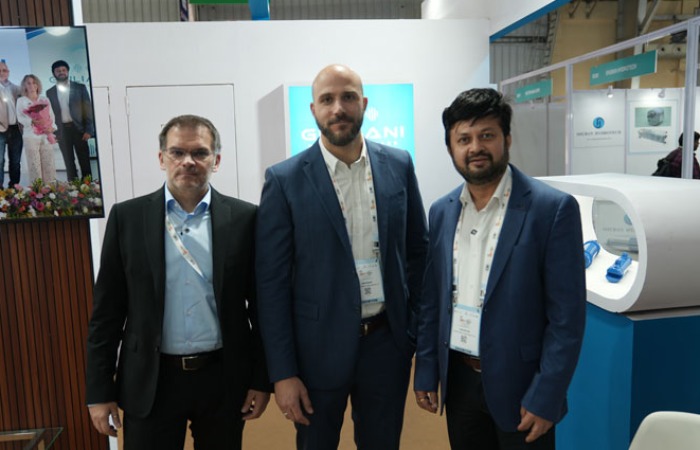
Abhikant Sahu, MD, Guiliani.
 A-303, Navbharat
Estates,
Zakaria Bunder Road,
Sewri (West), Mumbai - 400 015,
Maharashtra, India
A-303, Navbharat
Estates,
Zakaria Bunder Road,
Sewri (West), Mumbai - 400 015,
Maharashtra, India +91-22-24193000
 Subscriber@ASAPPinfoGlobal.com