
From Alwar to the World!
Metso’s Alwar plant combines manufacturing, engineering, lifecycle services and sustainable operations, with nearly two-thirds of its production destined for export markets.
A factory visit can tell you much more about a company than its product catalogue ever could. At Metso’s Alwar manufacturing facility in Rajasthan, what stood out was not just the scale of manufacturing, but the way production, engineering, quality, sustainability and customer support come together within a single industrial ecosystem.
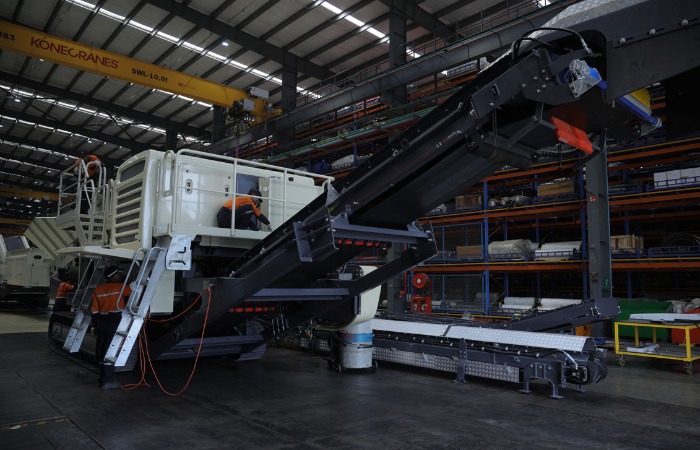
As I walked through the facility, the breadth of its operations became evident. From steel fabrication and machining to assembly and the manufacture of equipment for crushing, screening, material handling and sand washing, Alwar is much more than a conventional manufacturing plant. It is a key part of Metso’s global operations, serving the Indian market while supplying equipment and components to customers worldwide.
Operational since 2010 and spread across approximately 85 acres, Alwar is Metso’s largest manufacturing facility globally. Its scale reflects the growing importance of India in the company’s manufacturing strategy, as well as the opportunities emerging from the country’s infrastructure expansion.
A global manufacturing hub with an Indian foundation
The facility brings together multiple manufacturing units and product categories, with approximately 2,200 people working across its operations. Its portfolio includes track-mounted and wheeled plants, crushers, vibrating equipment, pumps, mill linings, rubber media and sand washing solutions, alongside other products and components for domestic and international markets.
What makes Alwar particularly significant is its integration into Metso’s global supply chain. Around 62 per cent of its production is exported, with the balance serving the domestic market. Equipment manufactured here reaches markets across Europe, the Americas, Asia and other regions.
Rakesh Thakur, Vice President – Manufacturing India, Metso, emphasises the importance of maintaining consistent manufacturing standards across the company’s global network. Equipment manufactured in India must meet the same quality expectations as products made at Metso’s other facilities worldwide.
The Alwar plant follows ISO 9001, ISO 14001 and ISO 45001 standards covering quality management, environmental management, and occupational health and safety. Metso also draws on its engineering resources in India, including centres at Vadodara and Alwar, to support product development, engineering and product maintenance.
The message is clear: manufacturing in India is not restricted to meeting domestic demand. Alwar is an integral part of Metso’s international manufacturing network, supplying both finished equipment and components to global markets.
Beyond production
While manufacturing scale is immediately visible, the value of a plant is ultimately measured by the performance of the equipment it produces. Deepak Raina, Vice President – Sales and Service Region (Aggregates), Metso, points to a fundamental shift in the aggregates business: customers are increasingly looking beyond equipment capacity and purchase price to assess productivity, product quality, operating costs, reliability and long-term returns.
Metso positions itself as a premium equipment supplier, but the value proposition extends beyond the initial investment. Higher productivity, lower power consumption, automation, reduced downtime, easier maintenance and improved operator safety all contribute to the total cost of ownership over equipment’s working life.
This is particularly important in crushing and screening operations, where the performance of an entire plant depends on several interconnected machines. A breakdown in a critical component can disrupt production, affect project schedules and compromise customer commitments.
Metso’s approach begins well before equipment reaches a customer’s site. The company conducts rock testing at its laboratory in Ahmedabad to understand the characteristics of the material to be processed. These findings help determine plant configurations and process flow sheets, supported by its Bruno simulation software.
By simulating plant performance, Metso can assess expected production, material shape and product quality before equipment is supplied. Performance testing before handover further connects the engineering design with the intended operating requirements.
This is particularly relevant in India, where rock characteristics vary across regions and influence crushing performance. Harder materials, including basalt found in parts of Maharashtra and Madhya Pradesh, present different processing challenges from other rock types. Equipment selection and plant configuration must therefore reflect the material and the customer’s production objectives rather than rely on capacity figures alone.
Automation: Centre of plant productivity
Automation is another area gaining importance as aggregates producers seek greater consistency, efficiency and safety. In a crushing plant, maintaining an appropriate feed level is essential. Insufficient feed can lead to inefficient operation, while excessive feed can affect performance and increase the risk of blockages.
Metso’s crusher automation systems monitor operating parameters and help regulate feeder speeds to maintain more consistent production. By reducing dependence on continuous manual intervention, these systems can help improve operational stability, equipment protection and energy efficiency.
Digitalisation extends this capability beyond the plant floor. Through Metso Metrics, the company’s cloud-based monitoring platform, customers can gain visibility into equipment performance, operating hours and other operating parameters. Such information can support maintenance planning and help identify potential issues before they develop into major interruptions.
Raina acknowledges that digital adoption in India is still evolving, with internet connectivity and customer readiness influencing implementation. Nevertheless, the potential is significant as plant owners move towards more connected, data-led operations.
The objective is not technology for its own sake. It is to give operators and plant owners better control over production, improve decision-making and enable faster service interventions.
Services: The relationship does not end at commissioning
If manufacturing establishes the foundation, aftermarket support helps sustain customer performance throughout equipment’s working life. This is an important part of Metso’s approach to the Indian aggregates industry, where plant availability and production continuity are critical to project delivery.
The company has a network of 70 dedicated service professionals across India, supported by regional operations, spare parts warehouses and repair facilities. Its service portfolio includes inspections, plant audits, preventive and predictive maintenance, upgrades, training, genuine spare parts, wear parts, repairs and refurbishment.
Metso’s Lifecycle Services (LCS) agreements take this relationship further. According to the company, 160 aggregate sites in India operate under LCS agreements. Depending on the scope of the contract, customers can engage Metso for a broader range of plant operations and performance support.
For businesses operating crushing and screening plants, this can reduce the burden of managing multiple maintenance activities while helping improve production reliability. During periods of intense road construction activity, when interruptions can affect project schedules, access to service engineers, parts and technical expertise becomes especially important.
Metso’s authorised repair facilities in Alwar and Bengaluru have a combined area of more than 4,400 sq m. These facilities support component repairs, refurbishment and equipment life extension, helping customers maintain their assets and obtain greater value from their investments.
Training is another part of the service proposition. Metso provides operator training at customer locations and designated centres, alongside training during equipment installation. The company also trains diploma engineering graduates before deploying them into field roles, helping build the technical capabilities needed to support customers.
The emphasis is on a relationship that continues well beyond the initial equipment sale, with service, training and lifecycle management playing a growing role in customer success.
M-sand and aggregates solutions
India’s infrastructure expansion is changing requirements across the aggregates value chain. As producers seek consistent material quality and efficient resource utilisation, manufactured sand, advanced screening and washing systems, and integrated processing circuits are becoming increasingly important.
Harpreet Singh, Vice President – Aggregates Sales, Metso, highlights the opportunities emerging from these changing market requirements. Metso’s portfolio spans crushing, screening, mobile and portable plants, vertical shaft impact crushing and sand washing solutions.
The company has expanded its washing capabilities in India, complementing its established crushing and screening portfolio. This allows Metso to offer more integrated solutions rather than requiring customers to coordinate separate suppliers for different stages of the processing circuit.
The benefit goes beyond procurement convenience. When crushing, screening and washing equipment are designed to work together, producers can better address material gradation, product quality and overall plant performance.
The portfolio includes Nordberg jaw and cone crushers, Lokotrack mobile crushing and screening equipment, Nordwheeler portable plants, Barmac vertical shaft impact crushers, TS Series screens and MWS sand washing solutions. Automation and digital monitoring further complement these offerings.
For aggregates producers, the focus is increasingly shifting from the specifications of individual machines to the productivity and performance of the complete plant.
Sustainability built into operations
The factory tour also highlighted the sustainability measures incorporated into Alwar’s operations. These initiatives extend from energy and water management to refurbishment and community engagement.
According to Thakur, solar installations generate approximately 26 per cent of the facility’s power requirement. Solar-powered street lighting uses stored energy, while the paint shop operates on electricity rather than diesel or gas for its heating requirements.
Water conservation is another focus area. Rainwater is collected and stored within the facility for reuse, helping reduce dependence on external water sources. The campus also incorporates green spaces and tree-planting initiatives.
For a company serving resource-intensive industries, sustainability extends beyond the equipment it supplies to the way products are manufactured, maintained and refurbished. Lifecycle services and refurbishment can help extend equipment life and reduce the need for premature replacement, supporting more efficient use of materials and resources.
Metso’s engagement with the surrounding community includes education, scholarships, eye-care programmes and support for local initiatives. These efforts underline the role of a large manufacturing facility not only as an industrial employer but also as a participant in the development of its neighbouring communities.
The visit offered a perspective on how India’s role in global manufacturing is evolving. Alwar combines manufacturing scale with engineering support, export capabilities, automation, aftermarket services and sustainability initiatives.
For Metso, this integration is central to serving both Indian customers and international markets. For the wider construction equipment industry, it illustrates why modern manufacturing facilities must deliver more than machines. They must also support product development, quality assurance, lifecycle performance and customer productivity.
As infrastructure investment expands and aggregates producers face increasing pressure to deliver consistent quality at competitive operating costs, these capabilities will become even more important.
The key takeaway from Alwar is that the future of aggregates equipment will not be determined by manufacturing capacity alone. Engineering-led solutions, intelligent automation, reliable services and a long-term understanding of customer requirements will increasingly define competitiveness.
At Metso’s Alwar facility, these elements come together under one roof — serving India’s infrastructure needs while supporting a global manufacturing network.
- Karthik Muthuveeran
 A-303, Navbharat
Estates,
Zakaria Bunder Road,
Sewri (West), Mumbai - 400 015,
Maharashtra, India
 +91-22-24193000
 Subscriber@ASAPPinfoGlobal.com