
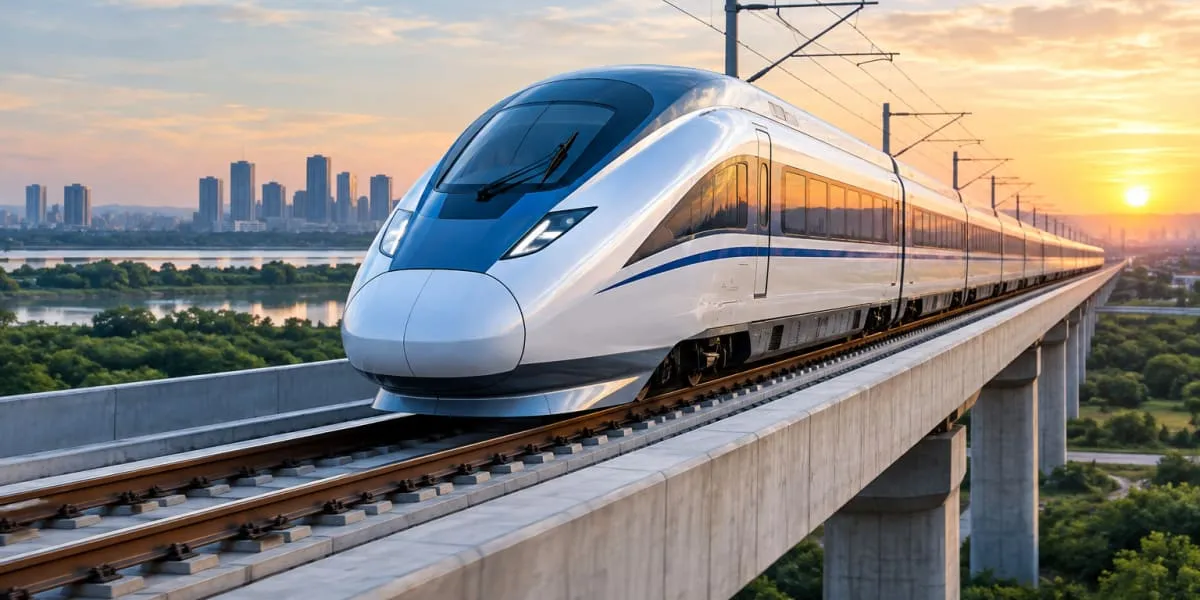
India’s First High-Speed Rail Service to Begin in 2027
India’s first high-speed rail service will commence in 2027, with the Surat-Vapi section of the Mumbai-Ahmedabad High-Speed Rail corridor scheduled to open first, Railway Minister Ashwini Vaishnaw said. The remaining sections to Mumbai will be opened in phases.
Vaishnaw said 456 km of pier work and 371 km of viaduct construction had been completed by September. About 600,000 noise barriers had been installed along a 299 km stretch, while 9,300 overhead equipment masts had been erected across a 206 km viaduct.
Four mountain tunnels have been excavated, and 5 km of the 21 km Maharashtra tunnel has been completed using the mountain tunnelling method. The corridor includes a 7 km undersea section beneath Thane Creek, forming part of India’s first undersea rail tunnel. Two tunnel boring machines launched in July 2026 from Vikhroli and Sawli are being used for the work.
Civil work has been completed at eight stations, with architectural finishing underway. Work is also progressing at rolling stock depots in Sabarmati, Surat and Thane. The project’s fixed infrastructure, including transformers, mast cross arms, ground wires, protection wires and feeder wires, is being manufactured domestically.
India’s first indigenous bullet trains are also under development. Integral Coach Factory and Bharat Earth Movers are manufacturing the B28 trainset, designed to operate at 280 kmph; its first body frame has been completed and is undergoing structural testing. Track trials are expected by mid-2027, while a B35 trainset designed for 350 kmph is planned as the next development.
Vaishnaw attributed the project’s delayed progress to pending permissions and land acquisition in Maharashtra, which held up work for nearly 2.5 years. The COVID-19 pandemic caused a further two-year interruption, while full construction began in 2021.
 A-303, Navbharat
Estates,
Zakaria Bunder Road,
Sewri (West), Mumbai - 400 015,
Maharashtra, India
 +91-22-24193000
 Subscriber@ASAPPinfoGlobal.com