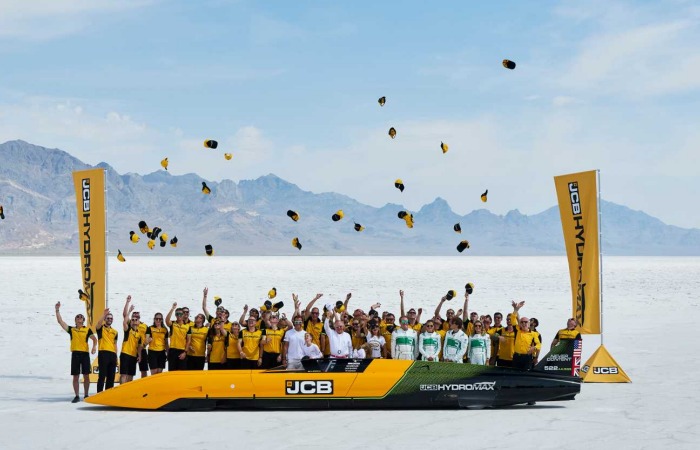
JCB Hydromax Sets Hydrogen Land Speed Record at 406.320 mph
British engineering major JCB has set a new world land speed record with its hydrogen-powered JCB Hydromax, achieving an average speed of 406.320 mph at the Bonneville Salt Flats in the US.
The 32-foot, twin-engined vehicle recorded 400.623 mph on its first run and 412.135 mph on the return run. The two speeds produced the record average of 406.320 mph, making it the fastest hydrogen internal combustion vehicle to have travelled on land, according to JCB.
Wing Commander Andy Green OBE drove the Hydromax during the record attempt. Under FIA regulations, the vehicle completed two runs in opposite directions within an hour. The achievement is subject to official ratification by the Fédération Internationale de l’Automobile (FIA).
The Hydromax surpassed the previous FIA-officiated hydrogen internal combustion benchmark of 185.5 mph, set by the BMW H2R in 2004. It also exceeded the 350.092 mph diesel land speed record established by JCB Dieselmax at Bonneville in 2006, with Green behind the wheel.
The company said the Hydromax also went beyond the 303 mph hydrogen fuel-cell speed mark, making it the fastest hydrogen-powered vehicle of any type.
The record was achieved in the FIA Category A, Group XIV, Class 7 World Flying Record Start Land Speed Record category. The Hydromax uses two production-based JCB hydrogen engines that generate a combined 1,600 bhp. The engines are manufactured at JCB’s facility in Foston, Derbyshire, UK.
JCB has invested £100 million in developing its hydrogen engine technology. The same engine platform is being introduced in JCB construction equipment produced in the UK.
JCB Chairman Lord Anthony Bamford said the record demonstrated the capabilities of hydrogen-powered internal combustion technology using production-based engines. He added that the achievement came 20 years after JCB Dieselmax established its diesel land speed benchmark at Bonneville.
Green described the Hydromax as stable, strong and fast, and said setting another world land speed record at Bonneville, two decades after driving Dieselmax, was a major achievement for the engineering team.
JCB Engineering Director Ryan Ballard said the project involved adapting a hydrogen digger engine for high-speed performance and demonstrated the capabilities of the company’s engineering team.
FIA President Mohammed Ben Sulayem described the achievement as a milestone demonstrating how innovation, performance and sustainability can work together. He said hydrogen combustion technology could contribute to the future of sustainable mobility.
Recently, JCB Hydromax also achieved 368.347 mph during Bonneville Speed Week, setting an SCTA record in the Blown Gas Streamliner AA/BGS class.
The latest achievement adds to JCB’s previous speed records. Its Dieselmax set the diesel land speed record of 350.092 mph in 2006, while the JCB Fastrac became the world’s fastest tractor at 135.191 mph in 2019. The JCB GT also achieved a backhoe loader speed record of 72.58 mph in 2014.
JCB has been developing hydrogen-powered construction equipment since unveiling prototype hydrogen backhoe loaders and Loadall telescopic handlers in 2021. More than 150 hydrogen combustion engines have so far been produced under the programme, with the first machines now entering production.
 A-303, Navbharat
Estates,
Zakaria Bunder Road,
Sewri (West), Mumbai - 400 015,
Maharashtra, India
A-303, Navbharat
Estates,
Zakaria Bunder Road,
Sewri (West), Mumbai - 400 015,
Maharashtra, India +91-22-24193000
 Subscriber@ASAPPinfoGlobal.com