Make-in-India cranes are gaining momentum
Excon has seen a strong focus on large-capacity cranes. What is driving this shift?
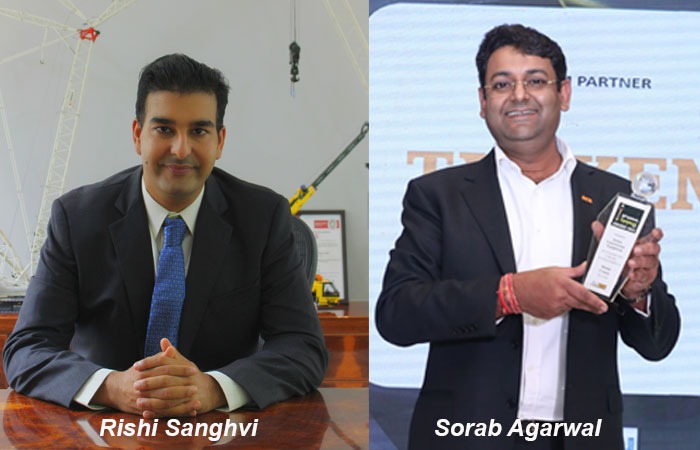
Sorab Agarwal (SA): Indias infrastructure expansion has entered a phase where scale and complexity are increasing rapidly. Projects today span metros, bullet trains, nuclear plants, large cement and steel facilities, refineries and urban infrastructure. These applications require higher-capacity crawler and mobile cranes, which has created a clear shift in demand.
How does the strategic partnership between ACE and Sanghvi Movers address this opportunity?
SA: We have entered into a strategic arrangement under which a significant share of our large-crane production over the next two years will be deployed with Sanghvi Movers. This includes both crawler and truck-mounted cranes. The partnership helps ensure that indigenously manufactured cranes are immediately tested and deployed by one of the most experienced rental players in the country. This is a long-term partnership. As crane capacities increase, we also aim to expand deployment across global markets. The ambition is to be an Indian manufacturer working with an Indian rental partner, supplying world-class equipment to projects worldwide.
Anti-dumping duties on low-priced imported cranes are an important development. Over the past several years, predatory pricing had distorted the market and discouraged local manufacturing. With the order in place and formal notification expected, manufacturing of large cranes is expected to return meaningfully to India, benefiting the entire ecosystem.
How does this align with the broader Atmanirbhar Bharat vision?
Rishi Sanghvi (RS): Infrastructure-led growth has been central to Indias post-Covid recovery. For decades, our aspiration has been to see large cranes manufactured in India. Today, the countrys largest crane rental company and a leading domestic manufacturer are partnering to build Indian infrastructure using Indian equipment. This is not just about replacing imports, but about building long-term capability.
What are the downstream benefits of domestic crane manufacturing?
RS: Local manufacturing strengthens the entire value chain ” from speciality steel and components to maintenance, aftermarket support and services. It creates jobs, builds technical know-how and significantly reduces turnaround time for service and spares. Over time, this ecosystem will also support exports and global competitiveness.
How critical is aftermarket support for large and complex cranes?
SA: Large cranes sit at the top end of complexity within construction equipment. Developing the capability to manufacture and service them builds industry-wide skills. Through this partnership, Sanghvis extensive service experience with imported cranes will help ensure that Indian-made cranes deliver consistent performance and uptime to end users.
Skilling remains a challenge. How are both organisations addressing this?
RS: Skill availability is a structural issue. We operate dedicated training centres with residential facilities, offering certified three-month technician programmes aligned with Vishwakarma Skill University. We train 300 to 400 technicians annually. In parallel, the Sanghvi Crane Training Academy certifies crane operators, prioritising safety and allowing trained operators to work across the industry, not just with us.
How important is operator safety in crane operations today?
SA: Most crane-related incidents arise from human error rather than equipment failure. We have integrated AI and IoT-based safety systems such as ALSS, SCOS and RAS, which create fail-safe operating conditions. At the same time, continuous customer and operator education on correct application and usage is critical, especially as crane sizes increase.
How are you managing scalability while maintaining quality?
SA: Scaling production is not just about volumes. Consistency and quality are more critical. Over the past two years, we have modernised our manufacturing processes, including autonomous and robotic production lines. The objective is to achieve global benchmarks ” and in some cases surpass them ” while scaling up capacity.
With BSV norms now in place, how has the transition progressed?
SA: All equipment ranges involving engines and registration have been upgraded to CE V-compliant electronic engines. This brings Indian-manufactured equipment at par with European Tier V standards, enabling direct export to global markets without additional modifications.
What is your outlook for 2026 and beyond?
RS: While 2025 was relatively flat due to elections, geopolitical factors and weather disruptions, infrastructure spending has started to accelerate. We see 2026 as a recovery year, with stronger growth from 2027 onwards. The current phase is one of consolidation, which is necessary before the next growth cycle.
 A-303, Navbharat
Estates,
Zakaria Bunder Road,
Sewri (West), Mumbai - 400 015,
Maharashtra, India
A-303, Navbharat
Estates,
Zakaria Bunder Road,
Sewri (West), Mumbai - 400 015,
Maharashtra, India +91-22-24193000
 Subscriber@ASAPPinfoGlobal.com