
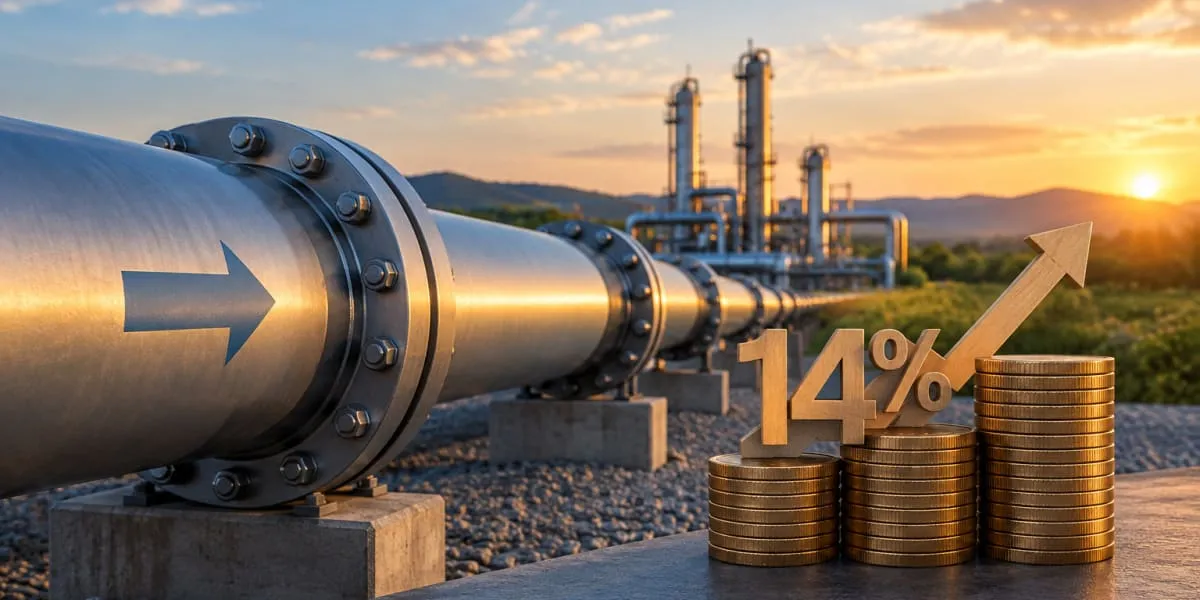
PNGRB Proposes 14 Per Cent Return for Natural Gas Pipelines
The Petroleum and Natural Gas Regulatory Board (PNGRB) has proposed a framework that would provide developers of natural gas pipelines with a fixed 14 per cent post-tax return on normative equity. The plan is intended to reduce investment risks arising from uncertain gas volumes and shift competition towards construction costs.
Under the proposed system, pipeline developers would be selected through competitive bidding based on the lowest capital expenditure quoted against a feasibility report. This would replace the current approach, under which bidders compete on transportation tariffs and capacity commitments. The regulator said the existing system had affected project viability when actual gas flows fell below projections.
PNGRB would appoint independent agencies to assess demand and prepare detailed feasibility reports covering technical specifications, project scope, expected demand and estimated capital expenditure. The reports would be released for public consultation before bidding documents are issued. The regulator would retain the right to reject bids considered unreasonably high or low, provided the reasons were recorded.
The proposed framework would remove annual transportation-volume targets for pipelines awarded through the new route. Developers would have to commission projects within 36 months of authorisation, although extensions could be granted for delays outside their control. Open-access capacity reserved for third parties would rise to 100 per cent of combined requirements, from 33 per cent currently.
The return would be calculated on a normative equity base equal to 30 per cent of the quoted project cost, assuming a 70:30 debt-equity ratio. For a project costing Rs. 100 bn, the normative equity base would be Rs. 30 bn. Normative debt would be repaid over 15 years after a three-year moratorium, while operating expenditure would be benchmarked at 2 per cent of project cost with annual escalation of 4.5 per cent.
Tariffs would be based on actual transportation volumes, with part of the benefit from utilisation above the higher of projected demand or 75 per cent of capacity passed to users. The concept paper proposes tariff true-ups every two years, while draft tariff regulations provide for reviews every five years and a benchmark interest rate plus one percentage point.
 A-303, Navbharat
Estates,
Zakaria Bunder Road,
Sewri (West), Mumbai - 400 015,
Maharashtra, India
 +91-22-24193000
 Subscriber@ASAPPinfoGlobal.com