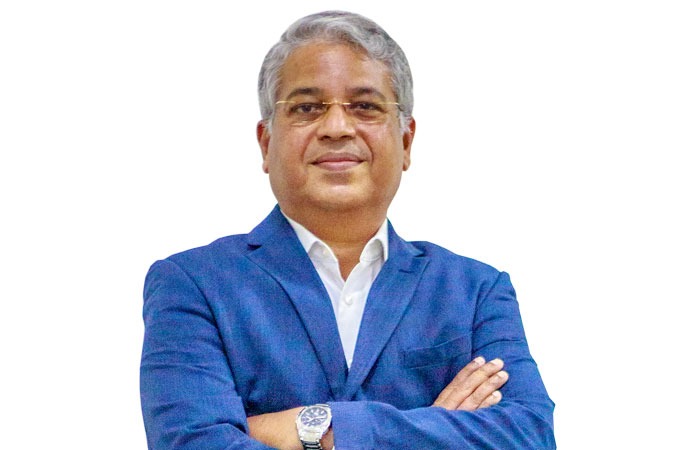
Precast is clearly the future for India
VG Sakthikumar, Chairman and Managing Director, Schwing Stetter India
What was the focus this year at Excon?
Excon has always been an important platform for us. Every product we display is developed with customer productivity, efficiency and sustainability in mind, along with increasing machine connectivity. This year, our focus was on showcasing new machines, technologies and collaborations that can help customers meet construction targets more effectively.
On the concrete pump side, after launching the 47-metre pump last year ” the largest manufactured in India at that time ” we have now showcased a 56-metre pump. The step-by-step progression is deliberate, keeping mounting feasibility in mind, particularly axle configurations that matter to customers.
We also displayed a 36-metre pump that now operates in hybrid mode. This reduces diesel dependency and has already seen repeat orders, indicating strong customer acceptance.
We displayed a dry mortar plant, which is being adopted for a variety of applications. Another highlight was a 45 cu m mobile batching plant that does not require a foundation and can be containerised. This reduces transportation costs substantially, particularly for export markets such as Africa, with savings passed on to customers.
Hybridisation is becoming increasingly relevant. In addition to hybrid truck-mounted pumps, we showcased trailer pumps with variable frequency drive (VFD) technology, which optimises power consumption and significantly reduces fuel usage. These solutions directly lower operating costs for customers and are seeing growing demand across regions.
We showcased three self-loading mixer models, focusing on maximising engine utilisation and efficiency. Higher efficiency translates directly into lower fuel consumption, which remains a key customer priority.
Precast and factory-based construction featured prominently at your stall. Why this emphasis?
Precast is clearly the future for India, especially for housing and infrastructure. We showcased equipment such as the cylinder finisher, which converts concrete into slabs and walls under controlled factory conditions. This approach improves quality, reduces material waste and accelerates project timelines. The government is also increasingly encouraging precast solutions.
How was the response to the technology and innovation zones at your pavilion?
The response was very encouraging. Our technology innovation booth showcased ten new technologies, including AI-enabled solutions that improve site coordination and productivity. We had over 600 registered visitors in this area alone, with very positive feedback on how these technologies can make construction sites more connected and sustainable.
Did Excon translate into immediate business outcomes?
Our objective was not to sell machines at the exhibition but to demonstrate capability. However, we still received two confirmed orders for the 56-metre pump, which reflects strong market confidence in indigenous high-capacity equipment.
To what extent are these products made in India?
When we entered India, our products were fully imported. Over time, most of our core products have become fully localised. Truck mixers and batching plants are now 100 per cent made in India. For new products, localisation increases progressively as volumes build.
How has the market environment been in 2025, and what is your outlook?
We recorded growth in 2025 compared to 2024, but not at the double-digit levels we have been accustomed to. This suggests the market could have performed better. We expect 2026 to be more positive as momentum in infrastructure and construction strengthens.
 A-303, Navbharat
Estates,
Zakaria Bunder Road,
Sewri (West), Mumbai - 400 015,
Maharashtra, India
A-303, Navbharat
Estates,
Zakaria Bunder Road,
Sewri (West), Mumbai - 400 015,
Maharashtra, India +91-22-24193000
 Subscriber@ASAPPinfoGlobal.com