Protecting the World's Largest Fleet
India’s construction equipment industry sold 1,36,995 units in FY26, and it isn't slowing down. ICEMA, the industry’s own association, expects India to become the world's second-largest construction equipment market by 2030, trailing only the US and China. That kind of growth is a genuine point of pride, a sign of how fast infrastructure, mining, and construction have scaled across the country. But growth like this carries a quieter implication too: more machines entering service, more of them exposed to the same hidden risk, one that rarely announces itself until it's already caused damage.
The Threat Nobody Sees Coming
Ask most operators what causes hydraulic failure, and the answer is usually wear and age. The real picture looks different. Data from 49,000 oil samples tested by the Mobil™ Lubricant Analysis lab reveals that 90 per cent of machinery failures are linked to lubrication issues, and contamination is the single biggest contributor*. Not a dramatic mechanical breakdown. Contamination, quiet, cumulative, and largely invisible until the damage is done.
It doesn't take much. Even minimal water contamination can cause rust, corrosion, and oil clouding, and bearing life expectancy can be reduced drastically with just a slight increase in water content. Hard particulates are just as unforgiving: hydraulic systems operate at clearances as small as 0.5 microns, small enough that a single stray particle can cause scoring, excessive friction, and eventual system breakdown.
Underneath all of this sits a basic mechanical reality. A typical hydraulic pump is only 80 to 90 per cent efficient to begin with, losing energy to mechanical friction and internal fluid leakage before contamination even enters the picture. Add contamination to that baseline inefficiency, and the gap between what a system should deliver and what it actually delivers only widens.
The First Line of Defence: Mobil DTE™ 10 Excel
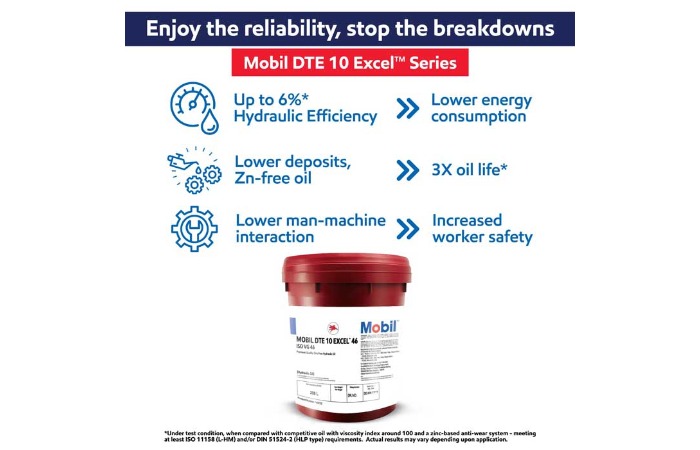
This is precisely the environment Mobil DTE™ 10 Excel Series is engineered for. In controlled laboratory efficiency testing, it was measured to provide up to a 6 per cent improvement in hydraulic pump efficiency compared to Mobil standard hydraulic fluids*. Beyond efficiency, it has demonstrated exceptional oil life, outlasting standard hydraulic fluids by up to three times based on Mobil Hydraulic Fluid Durability testing, while maintaining outstanding system cleanliness, operating successfully in temperatures as low as -34°C.
These aren't just laboratory numbers. In a real-world excavator demonstration, the same fluid delivered:
- 6 per cent less fuel consumed per cycle
- 5 per cent less time required per cycle
- Up to 900 gallons of fuel saved and 9 metric tons of CO2 reduced over a full year of operation***
For a fleet growing at India's pace, gains like these compound fast, one machine, one cycle, one year at a time.
The Second Front Nobody Talks About: Seals
Efficiency and oil life solve half the problem. The other half is quieter still: seal integrity. As oil degrades or contamination builds, seals are often the first point of failure, and once a seal starts leaking, contaminants have a direct path into the system. Mobil DTE™ 20 Series is built with carefully balanced seal compatibility, helping reduce leakage and contaminant ingress, and extending the working life of critical components.
It's an easy thing to overlook, until it isn't. A well-protected pump running on a compromised seal is still a system with an open door.
Staying Ahead of a Fast-Growing Fleet
Becoming the world's second-largest construction equipment market is an ambition worth protecting, not just chasing. The equipment already entering service, already running, is already exposed to exactly the risks outlined here. The question for India’s heavy equipment operators isn't whether contamination and efficiency loss are real threats, the data already answers that. It's whether the fleet being built today is being protected as deliberately as it's being expanded.
Growth of this scale rarely announces its risks the way it announces its numbers. A pump losing efficiency, a seal quietly wearing thin, contamination working its way through a system, none of it shows up in a sales report, but all of it shows up eventually in downtime, repair costs, and equipment pulled off the job earlier than it should be. Protecting a fleet this size isn’t a single fix. It's pairing the right fluid with the right defences, efficiency and oil life through Mobil DTE™ 10 Excel, seal integrity through Mobil DTE™ 20, so that as India's construction equipment industry climbs toward that second-largest ranking, the machines making that climb possible are built to last the distance.
Fill with Mobil™. Fill with Confidence.
For more information, visit www.mobil.in/business
*Based on 49,000 oil samples tested by MLA lab.
**The energy efficiency of Mobil DTE 10 Excel™ relates solely to the fluid performance when compared to conventional Mobil-branded hydraulic fluids. The technology used allows up to 6 percent increase in hydraulic pump efficiency compared to Mobil DTE™ 20 series when tested in standard hydraulic applications under controlled conditions. Results may vary based on operating conditions and equipment.
***This performance is based on the experience of a single customer. Actual results may vary.
Exxon Mobil Corporation has numerous affiliates, many with names that include ExxonMobil, Exxon, Esso, and Mobil. For convenience and simplicity, those terms, and references to "corporation," "company," "ExxonMobil," "EM," and other similar terms are used for convenience and may refer to one or more specific affiliates or affiliate groups.
ABOUT THE AUTHOR:
Abhinav Jogi, General Manager - Commercial Marketing, South Asia Pacific, ExxonMobil Lubricants.
 A-303, Navbharat
Estates,
Zakaria Bunder Road,
Sewri (West), Mumbai - 400 015,
Maharashtra, India
A-303, Navbharat
Estates,
Zakaria Bunder Road,
Sewri (West), Mumbai - 400 015,
Maharashtra, India +91-22-24193000
 Subscriber@ASAPPinfoGlobal.com