
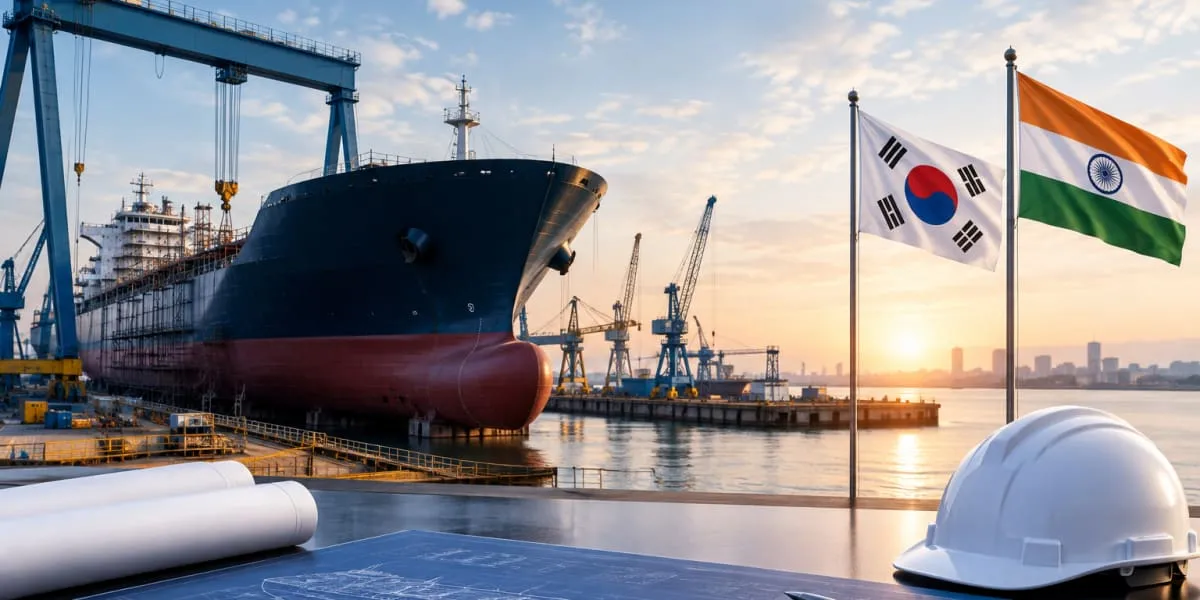
Samsung Heavy Industries Explores Shipbuilding Investment in India
South Korea’s Samsung Heavy Industries (SHI) is exploring investments in India’s shipbuilding sector as its domestic yards are booked for the next three years and cannot accommodate additional orders while maintaining delivery schedules for global customers. The company is assessing India as an alternative manufacturing base for handling overflow from its Korean facilities, according to a report by Mint citing a senior company official.
SHI may deepen its existing partnership with Swan Defence and Heavy Industries (SDHI) at the latter’s Pipavav shipyard in Gujarat. The strategic memorandum of understanding between the companies, which covers commercial shipbuilding and heavy engineering projects, could be converted into an investment agreement for the joint manufacture of large vessels.
The proposed investment would support facilities capable of building tankers, gas carriers, container ships and other specialised vessels for international customers. SHI currently operates under a licence-led partnership model in India, providing designs, engineering support and material packages, while SDHI undertakes construction.
An equity investment could follow the completion of initial projects under the partnership. SDHI is executing orders for six chemical tankers from Norway’s Rederiet Stenersen and four Kamsarmax bulk carriers from NEO Fund, while it has also emerged as the lowest bidder for a contract to build four dual-fuel-ready medium-range product tankers.
The tanker contract has been offered by a joint venture led by Shipping Corporation of India. Beyond Pipavav, SHI is exploring greenfield shipbuilding opportunities in India’s proposed maritime clusters and a possible partnership with state-run Cochin Shipyard for a planned ship block fabrication facility in Kerala.
The development comes as India seeks to attract global shipbuilders through a $7.8 bn shipbuilding package announced in 2025. The proposed expansion of manufacturing capacity is intended to support domestic and international vessel demand while strengthening India’s position in the global maritime supply chain.
 A-303, Navbharat
Estates,
Zakaria Bunder Road,
Sewri (West), Mumbai - 400 015,
Maharashtra, India
 +91-22-24193000
 Subscriber@ASAPPinfoGlobal.com