Scaling Up Safety and Productivity
Descaling buildup in preheater towers and other vessels is one of those tasks that needs to be done, but no one looks forward to doing. The good news is that the dangers and cumbersome nature of traditional descaling have driven innovation, resulting in an alternative to sending workers into these vessels with scaffolding and hand tools.
Recent advancements in robotic technology offer an automated solution that, first and foremost, keeps workers out of the vessel while breaking down buildup. At the same time, plants are completing the task faster with less labour. Implementing new technology doesnt come without an initial investment, but its well worth it to protect the health and lives of personnel, reduce labor allocated to the descaling task and get back to regular operation up to 10 times faster.
Productive practicesÂ
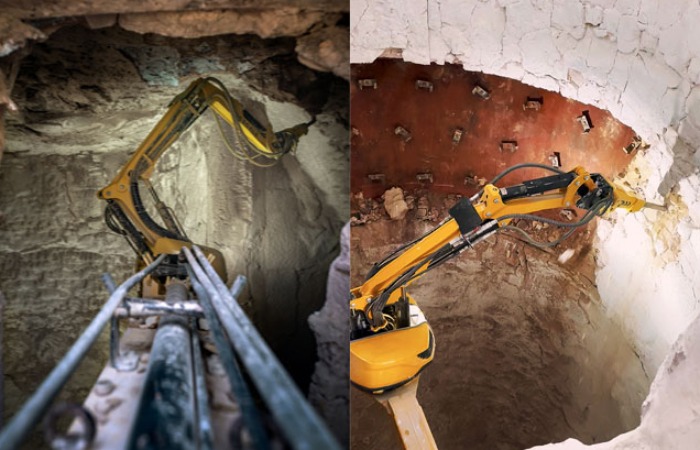
So, what is this new descaling option? The upper carriage of a remote-controlled demolition robot sits on top of a telescoping arm that extends into the vessel through a hatch. The robot features an extendable arm and a chisel on the breaker to break out buildup. To run the machine, the operator is positioned outside the vessel, using a control box to break material inside the vessel.Â
Productivity gains start with transportation and setup. Before the first installation, the descaler requires one-time site prep to create a 4-foot-by-4-foot (1.2-m-by-1.2-m) hatch for the telescoping arm. But, once the access point is created, the descaler takes less than three hours to install. That means that a team can set up and get a good start on the descaling process in a single shift. The telescoping arm can be broken down into three parts that fit into an elevator to easily transport to the hatch height.Â
Pairing the telescoping arm with a flexible three-part arm means outstanding reach from multiple angles. Descalers have a reach of 16 feet (5,000 mm) above the robot and 10 feet (3,000 mm) below. The three-part arm allows the machine to work directly above and below the body and includes a 6-foot (1,800-mm) chisel for extra reach, leaving the descaler capable of cleaning a vessel with a diameter up to 30 feet (9 m).Â
Mechanizing descaling also reduces labor needs. Installation and operation only require two personnel plus a cleanup crew compared to 10-15 crew members to erect scaffolding and descale with handheld tools. Manual methods of descaling, on the other hand, require up to 15 workers ” making an average of $30 per hour ” with jackhammers or rivet busters an eight-hour shift or $3,600 in wages compared to two workers with a robotic descaler. Thats 10 times the productivity at 20 per cent of the labor cost, and none of the dangers of crew inside the vessel. Â
But that doesnt even touch the value of improving worker safety.

Safest approach
The dangers of descaling are well known and universally dreaded. Previous manual methods required workers to be positioned inside the vessel, exposed to heat, dust, potential falling debris and other hazardous conditions. Visibility was low; and the physical requirements of the job could cause strains, sprains, dehydration, burns and other injuries, not to mention the risks of working at height. Thats not even mentioning the dangers of swaying and unsteady platforms with scaffolding.Â
In the past, this was seen as a necessary evil without any real alternative, and everyone did their best with the resources they had. Now, robotic descalers address many of the dangers of descaling meaning its no longer necessary for crews to be in that position. Remote-controlled descalers can withstand extreme temperatures through hydraulic cooling that prevents breakdowns in high heat, with some able to work at around 158 degrees F (70 degrees C). The remote-controlled operation allows operators to position themselves safely outside the vessel but near the vessel hatch with an unobstructed view of the work area. Because operators must be close to the vessel opening, descalers come with PPE ready to go.Â
Like all demolition robots used in the cement and processing industries, the added safety prevents costly workmans comp costs, offsetting the initial purchase price and protecting something much more priceless ” the health and safety of the maintenance team.Â
A Foregone ConclusionÂ
Metal processing and cement facilities can save thousands of dollars a year by investing in a high-quality robotic descaler. The immense safety benefits combined with higher productivity saves facilities time and money while offering a safer working environment. When the purchase of innovative equipment comes down to the math of whats more cost effective, the choice is obvious.Â
Footnote:
Jeff Keeling is Vice President of Sales & Marketing at Brokk Inc.
 A-303, Navbharat
Estates,
Zakaria Bunder Road,
Sewri (West), Mumbai - 400 015,
Maharashtra, India
A-303, Navbharat
Estates,
Zakaria Bunder Road,
Sewri (West), Mumbai - 400 015,
Maharashtra, India +91-22-24193000
 Subscriber@ASAPPinfoGlobal.com