
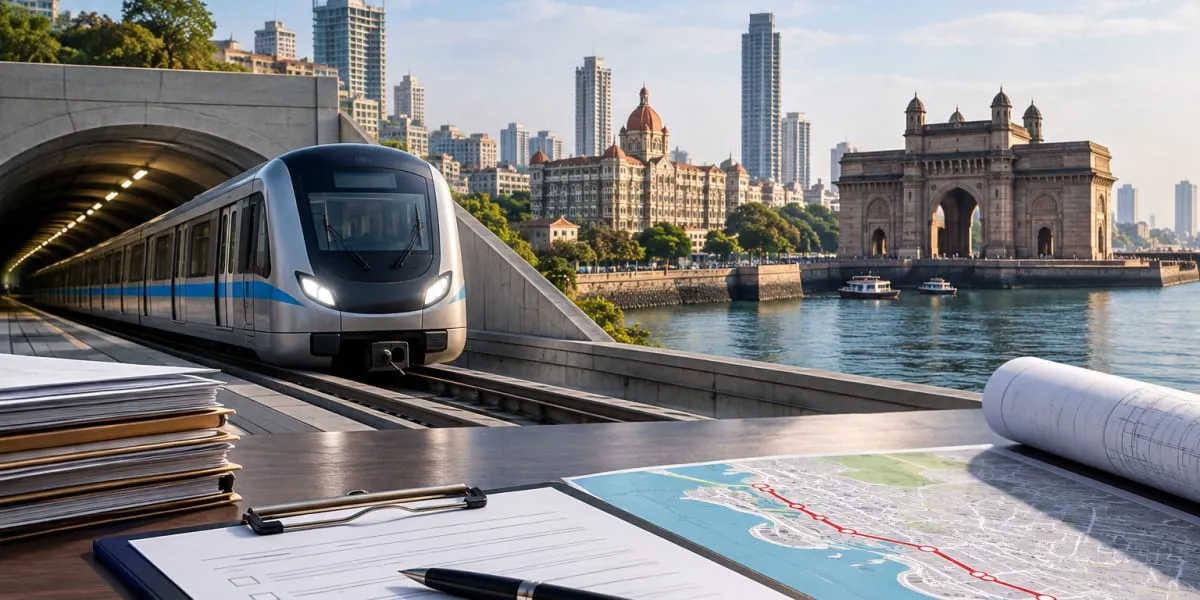
Survey of 800 Structures Along Wadala-Gateway Metro Begins
The Mumbai Metro Rail Corporation (MMRC) has begun a baseline socio-economic survey covering approximately 800 buildings and structures that could be affected by the planned 17.5-km underground Mumbai Metro Line 11 between Wadala and the Gateway of India. The corporation’s Rehabilitation and Resettlement Department issued a public notice on Monday regarding the exercise.
Property owners and occupants have been asked to cooperate with the survey team and provide relevant documents. These include Aadhaar cards, electricity and water bills, property tax receipts, property cards, rent receipts, rent agreements, ration cards, Index-II documents, occupancy certificates and business licences.
Socioquest Solutions, an agency appointed by the government, will conduct the survey on behalf of the metro corporation. Its representatives will take measurements and record photographs and videos to assess occupants’ socio-economic conditions and establish baseline information about the properties.
Owners and occupants have been asked to keep original documents and photocopies available for authorised representatives. Residents seeking further information have been directed to the MMRC Coordination Committee office near the Suburban Collector’s Office.
All 14 stations on the proposed corridor will be underground. The planned route includes Anik Depot, Wadala Depot, CGS Colony, Ganesh Nagar, BPT Hospital, Shivdi, Haji Bunder, Darukhana, Byculla, Nagpada Junction, Bhendi Bazaar, CSMT Metro, Horniman Circle and Gateway of India.
The project is receiving financial assistance from the Japan International Cooperation Agency (JICA), which has agreed to provide the Indian government with an official development assistance loan of 92.4 bn yen for the first phase up to Wadala. The corridor is estimated to cost Rs. 234.87 bn and is targeted for completion by August 2032. A 6.9-km extension to Bandra Railway Terminus via Dharavi was approved by the Maharashtra government in March, although feasibility and related studies remain incomplete.
 A-303, Navbharat
Estates,
Zakaria Bunder Road,
Sewri (West), Mumbai - 400 015,
Maharashtra, India
 +91-22-24193000
 Subscriber@ASAPPinfoGlobal.com