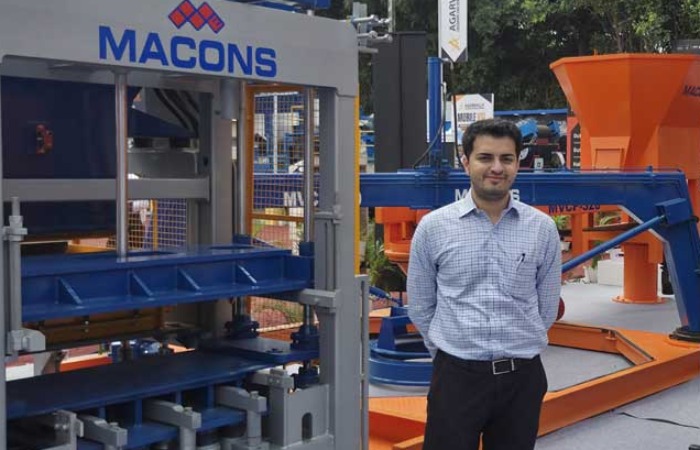
The idea was to have an Italian design, but Indian prices
Could you give us an overview of Macons Equipments and its product portfolio?
Macons Equipments was established in 2000, with concrete batching plants forming the core of our business. We started with the MA Series of mobile batching plants, developed through a technical collaboration with a Danish company. At the time, we introduced five models along with several variants, with capacities ranging from 12 cu m per hour to 25 cu m per hour.
Over the years, we have continued to expand the portfolio. Our range today includes concrete batching plants, road construction equipment, precast machinery, truck-mounted cranes and self-loading concrete mixers. The objective has been to provide a wider range of solutions for customers across different construction applications.
How has your concrete batching plant range evolved over the years?
Initially, the industry largely relied on scraper-type or star-type batching plants. Around 2007-08, we introduced the MAC Series compact batching plants as a more efficient alternative.
The MAC Series was designed as a quick, plug-and-play solution. Around 95 per cent of the assembly is completed at our factory, which significantly reduces work at the customer’s site. Typically, erection and commissioning can be completed within seven to eight days.
We have also expanded into inline batching plants, with capacities ranging from 30 cu m per hour to 240 cu m per hour. Durability remains an important part of our design philosophy. We build our plants with long-term usage in mind rather than focusing only on reducing initial equipment weight or cost.
Beyond batching plants, which other construction equipment segments have you entered?
We have expanded into road construction equipment with plants ranging from 120 tph to 350 tph, along with kerb-laying machines. We offer both track-mounted and wheel-mounted variants depending on the customer’s application.
More recently, we have entered the precast segment. Our MVCP Series is designed for producing concrete pipes, box culverts, U-drains and manholes using vertical casting technology.
We also offer the MBM Series for manufacturing concrete blocks, bricks, pavers and kerbstones. For this segment, we chose to work with an established technology partner because we wanted to bring proven technology to the market rather than develop products through trial and error.
You have also entered the truck-mounted crane segment. What was the approach behind this diversification?
We introduced a truck-mounted knuckle-boom crane range through a technical collaboration with an Italian company.
The idea was to have an Italian design, but Indian prices. We brought the manufacturing process, jigs and fixtures to India, and their technical team also trained our team here for about a month.
We follow the same manufacturing processes and material requirements while producing the equipment in India. This allows us to offer established international technology at a cost suited to the Indian market. We have also introduced self-loading concrete mixers compliant with the latest emission regulations.
How important is after-sales support, particularly as your product portfolio expands?
Our first approach towards after-sales service begins with the design of the equipment itself. We try to use standard components and build machines robustly so that maintenance requirements can be minimised over the equipment lifecycle.
At times, that can result in a higher initial cost, but we do not want to compromise on component quality simply to reduce the selling price.
For field support, we currently have around 20 dealers across India and approximately 40 service engineers, in addition to the service personnel employed by our dealers. Dealers also maintain spare-parts inventories in different regions, which help us, respond to customer requirements more quickly.
What level of localisation have you achieved across your equipment range?
Our approach from the beginning has been to bring global technology to India while progressively localising the equipment. For several products, we have reached essentially complete localisation in terms of sourcing components from within India. Some components come from multinational suppliers, but where those companies manufacture through their Indian operations, the components are sourced locally.
The larger objective is to make international technologies accessible to Indian customers while strengthening manufacturing capabilities within the country.
What will be the focus for Macons as you expand the portfolio further?
We are continuing to look at new products, particularly within the precast segment. The construction industry is becoming more diverse in terms of equipment requirements, so we see an opportunity to expand into complementary technologies rather than remain confined to one category.
Our focus will therefore be on broadening the portfolio and providing more integrated solutions for customers involved across different areas of construction.
 A-303, Navbharat
Estates,
Zakaria Bunder Road,
Sewri (West), Mumbai - 400 015,
Maharashtra, India
A-303, Navbharat
Estates,
Zakaria Bunder Road,
Sewri (West), Mumbai - 400 015,
Maharashtra, India +91-22-24193000
 Subscriber@ASAPPinfoGlobal.com