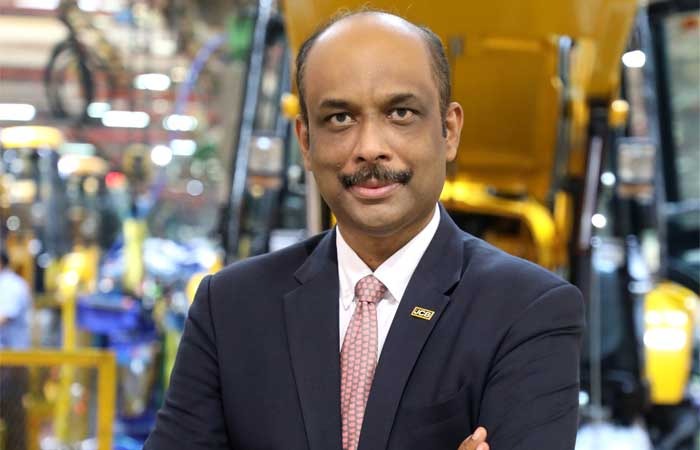
There will not be one solution; there will be multiple solutions
-Deepak Shetty, Managing Director and CEO, JCB India
What are the key highlights of JCB India’s showcase at bauma ConExpo 2026?
We are showcasing a broad range of equipment, with 21 products on display, including 10 new launches. A major focus is our new generation of backhoe loaders – the 3DX, 3DX Plus and 3DX Super – where we have worked extensively on productivity, fuel efficiency, total cost of ownership and operator experience.
We have also introduced products across excavators, mini excavators, agriculture, gensets, wheel loaders and access platforms. These include the JCB 150 FM and 225 XT excavators, the 18Z mini excavator, AGRIMAX 4WD, G160QI genset, 475-5 wheel loader and A60E access platform.
The underlying approach is to keep improving what we offer customers. Fuel cost continues to be a major concern, so we are looking at how machines can deliver better fuel efficiency, productivity and maintenance economics.
How is the rising focus on total cost of ownership influencing machine development?
Total cost of ownership is not only about fuel efficiency and productivity. Maintenance intervals are equally important. A machine may be economical to operate, but if it has to frequently visit a service centre, the customer loses productive time.
When we transitioned to Stage V machines, we were confident that they would provide customers with better fuel efficiency, higher productivity and lower maintenance requirements. We have continued to work on these areas with the latest machines as well.
Over the past 10 years, we have improved fuel efficiency on our backhoe loaders by almost 50 per cent. Telematics has also become important because customers can now see actual machine performance rather than depend only on stated figures.
You have spoken extensively about the operator while developing the new machines. How are operator requirements changing?
The operator’s voice is becoming stronger and stronger. Customers are increasingly asking us to do more for operators because a comfortable and properly trained operator can use a machine more efficiently.
We have therefore looked at even the smaller details inside the machine. An operator can sometimes spend 18 hours or more in the cabin, so ergonomics, visibility, storage, displays and overall ease of operation matter significantly.
In the new backhoe loader range, for instance, greater attention has been given to cab interiors, controls, seating, storage and displays. The objective is not simply to improve the machine technically but also to improve the environment in which the operator works.
How do you assess the current construction equipment market, particularly backhoe loaders and excavators?
There is a perception that the excavator market has been growing rapidly. However, if exports are removed from the numbers, the domestic excavator market has more or less remained at around 20,000 machines.
At the same time, the backhoe loader market is growing. We also have the AGRIMAX creating another segment, which we expect to add around 1,200 machines.
Compared with the preceding two years, when the overall industry recorded strong growth, the market has been relatively subdued. However, we have continued to see demand across product categories.
Exports have become increasingly important for JCB India. How is India’s role within JCB’s global manufacturing network evolving?
Last year, we exported almost 14,000 machines from India. What is particularly significant is that our largest export market was the US. Traditionally, exports from India across different industries have often been associated with developing markets, but our machines manufactured here are also going to developed economies.
We do not operate separate domestic and export production lines. The person manufacturing a machine does not necessarily know whether that machine is going to Nagpur, Japan, the US or another market. That helps ensure that domestic customers also receive machines manufactured to the same standards.
India-made JCB machines are now exported to more than 135 countries. We have six manufacturing facilities in India, while our engineering centre in Pune has more than 770 engineers developing products for markets around the world.
How important is designing and engineering equipment specifically in India?
Our strength is that we engineer products in India based on the requirements of Indian customers, while also making these products relevant to international markets.
For example, even our 52-tonne machine has been engineered in India and is now exported globally. Our scissor lifts are manufactured only in Jaipur and exported to markets around the world, while our compactors are also manufactured in India for global markets.
Engineering is therefore an important part of India’s role within JCB. We also work closely with our colleagues in the UK, developing technologies and products together. It is not only about manufacturing in India; increasingly, it is also about engineering in India.
With skilled operators remaining a challenge for the industry, what initiatives are you undertaking?
Skilling is a national opportunity because of India’s demographic dividend, and we take this responsibility seriously. Through our 14 skill centres, we expect to train more than 6,000 operators this year.
One challenge is that the cost of training operators on actual machines increases when fuel prices rise. Globally, simulators provide an alternative, but imported simulators can cost Rs 2-2.5 million. Our engineering team has therefore developed the JCB Daqsh training simulator.
A large part of an operator's initial training can be completed on the simulator without consuming fuel, followed by practical training on the actual machine. This becomes especially important as machines become more sophisticated.
A properly trained operator can use equipment more safely and efficiently. The certification also gives operators skills that can help them find employment not only in India but internationally.
How are digital technologies changing equipment monitoring and customer support?
Telematics allows us to remain connected with machines and customers regardless of where the equipment is operating. Today, we have telematics installed on more than 300,000 machines.
Technologies such as JCB LiveLink enable customers to monitor machines in real time, including aspects of performance, maintenance and diagnostics. This helps improve fleet visibility and uptime.
The physical support network is equally important. We have more than 700 outlets across India and around 6,500 engineers supporting customers. We also maintain a substantial parts inventory so that support can be provided in hours rather than days.
Anybody can set up a factory and manufacture equipment, but supporting customers across India's large geographic footprint is a different challenge.
How do you see electric, hydrogen and other alternative-fuel technologies developing in construction equipment?
We believe different technologies will make sense for different applications. There will not be one solution; there will be multiple solutions catering to different customer requirements.
Smaller and more compact machines, particularly those operating in urban environments, could increasingly become electric. We already have electric access equipment, including scissor lifts and the A60E.
However, around 70 per cent of our machines are sold in rural India, where equipment is often involved in building roads or water infrastructure. In some of these locations, reliable charging infrastructure may not yet be available. We therefore have to consider the operating environment rather than assume that one technology will work everywhere.
For larger machines, we see hydrogen as one potential solution. In mining, for example, an electrolyser could potentially be located at the site and hydrogen generated locally.
JCB has already developed a hydrogen combustion engine, and the machine technology is ready. The key requirement now is the development of supporting infrastructure and standards. As that ecosystem develops, we will be ready with the machines.
What are your expectations for production and exports going forward?
We expect exports this year to be around 15-20 per cent higher than last year. In terms of production, we expect to manufacture more than 70,000 machines.
More broadly, our focus will remain on developing products in India for both domestic and international customers, improving fuel efficiency and productivity, strengthening operator capabilities and ensuring that customers receive reliable support throughout the machine lifecycle.
 A-303, Navbharat
Estates,
Zakaria Bunder Road,
Sewri (West), Mumbai - 400 015,
Maharashtra, India
A-303, Navbharat
Estates,
Zakaria Bunder Road,
Sewri (West), Mumbai - 400 015,
Maharashtra, India +91-22-24193000
 Subscriber@ASAPPinfoGlobal.com