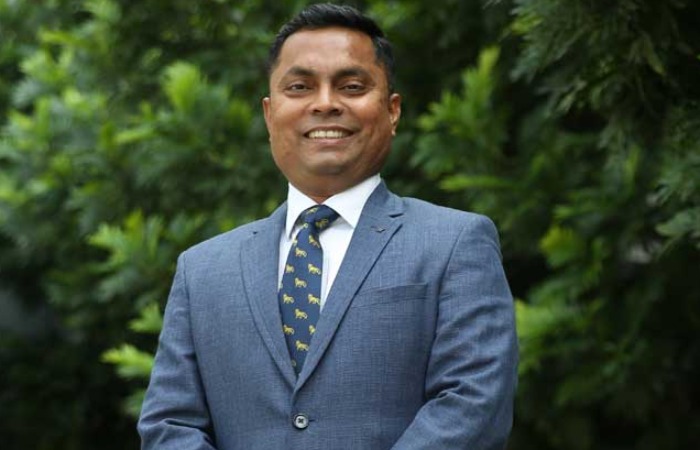
We intend to go with the strategy of service as a product
What were the key new products showcased by Ammann India at bauma CONEXPO India 2026?
We introduced several new products at bauma CONEXPO India 2026. One of the key launches was a 36-m concrete boom pump. We also showcased a new CC60 variant and the CPS 70 stationary concrete pump.
In compaction equipment, we introduced the ARX 26 mini tandem roller, a 2.6-tonne machine, along with the ARW 65 walk-behind roller, which further expands our road equipment portfolio.
At the larger end of the range, we have brought back the AP 1000, a 9.5-m paver, in its BS-V version. We previously offered this machine in the BS-III version, where it was popular among several of our long-standing Apollo-series customers.
Ammann has traditionally had a strong presence in road equipment. How significantly have you expanded into concrete machinery?
Ammann acquired Elba, a German concrete equipment company, in 2013-14. We had been evaluating a larger entry into the concrete equipment segment for some time and, over the past couple of years, have entered this market in a more substantial way, both in India and globally.
Road-building equipment, however, remains one of Ammann's largest portfolios. We offer equipment across the road construction cycle, beginning with asphalt plants, including drum-mix and batch-mix plants. We have also moved into higher-end recycling plants.
This is followed by our paver range. We have mechanical pavers that are widely used for rural roads and state highways, sensor pavers and larger track pavers extending up to 13 m.
What level of localisation has Ammann achieved across its equipment portfolio in India?
The level of localisation varies from product to product, but the majority of our equipment has a very high localisation level. For several products, it is around 90-95 per cent or higher.
There are a few exceptions, particularly some of the larger machines, such as the 13-m paver, which is currently fully imported from our core paver manufacturing facility. However, most of the products displayed here have localisation levels of more than 85-90 per cent and are manufactured at our Mehsana facility in India.
The road equipment market has remained relatively flat in recent months. How do you assess the current market situation?
We had a reasonably good beginning to the year, particularly during January, February and March. Thereafter, geopolitical developments in West Asia, along with issues related to bitumen prices and the availability of diesel and bitumen, affected activity at several project sites. Some sites were not operating at full capacity, while others had to stop operations.
This had a dampening effect on overall demand. The past three to four months have therefore been extremely flat, and it has been a challenging period specifically for road equipment.
However, the fundamentals are still in place. India remains a growing market, and there will continue to be a requirement for new roads as well as for maintaining the roads constructed over the past 10-15 years. We therefore expect the market to recover from the slowdown.
How is the transition towards cleaner and more sustainable construction technologies progressing in India?
Customer awareness has increased considerably, and the required technologies are available. For instance, we have recycling plants that can recycle road aggregate and bitumen to levels of nearly 60 per cent.
The circular economy is also gaining greater attention. There is considerable discussion around sustainability and smart construction, with greater emphasis on preserving the environment and making both equipment manufacturing and road construction more sustainable.
The transition is happening, and customer awareness of these technologies is steadily increasing.
Where do you see the key growth opportunities for Ammann India over the next few years?
We are looking at growth in both the domestic and export markets. From India, we currently serve more than 100 countries around the world.
As a group, Ammann is also looking at developing India as a significant supply base for certain products serving emerging and developing markets. We therefore see considerable growth potential, particularly in exports.
Another important area is the service capability we have built. We intend to go with the strategy of service as a product. There is considerable opportunity to generate value by getting closer to customers and finding more ways to support them throughout the equipment lifecycle.
Markets will continue to go through cycles and occasional disruptions, but we have to remain prepared for them while continuing to build these capabilities.
Availability of skilled manpower remains a challenge for the construction equipment industry. What skilling initiatives are you undertaking?
We undertake several skilling initiatives through the Ammann Academy. We have structured training calendars for customers as well as our own teams. We are also associated with ICEMA and the Skill Development Council, and our training facilities are certified.
Programmes are conducted throughout the year for customer operators and supervisors, dealer teams, and our own service and sales personnel. Overall, we train close to 1,000 people annually.
The training is largely hands-on. We have created simulation boards using actual components from machines, equipment and plants. This allows an operator, supervisor or service professional to learn in an environment that closely resembles operating an actual machine or plant. We intend to strengthen this further because skilling is the need of the hour for the industry.
 A-303, Navbharat
Estates,
Zakaria Bunder Road,
Sewri (West), Mumbai - 400 015,
Maharashtra, India
A-303, Navbharat
Estates,
Zakaria Bunder Road,
Sewri (West), Mumbai - 400 015,
Maharashtra, India +91-22-24193000
 Subscriber@ASAPPinfoGlobal.com