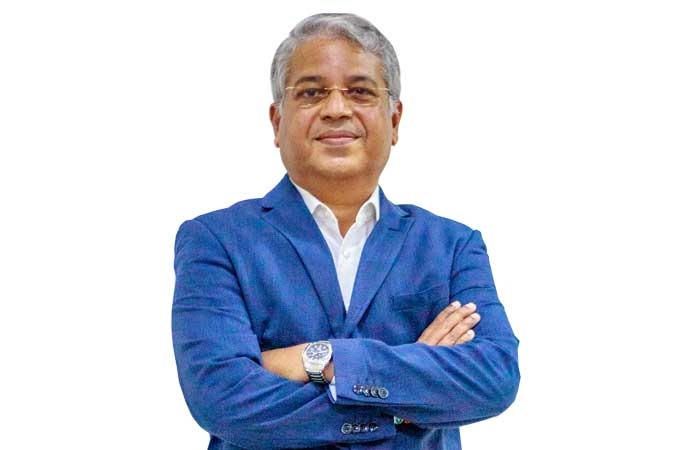
We will unveil five new products
VG Sakthikuma, Chairman & Managing Director, Schwing Stetter India
What are the key products or technologies you are showcasing at Bauma CONEXPO India, and what makes them particularly relevant to the evolving needs of Indian customers?
At bauma, we are planning to unveil close to five new products, besides new-generation versions and configurations across our portfolio. Our showcase will cover batching plants, truck mixers, concrete pumps and boom pumps, self-loading mixers and concrete recycling solutions, with greater emphasis on automation, intelligent controls, telematics, IoT connectivity and advanced diagnostics.
Indian customers today are looking beyond machine capacity; they want higher productivity, dependable uptime, lower fuel and energy consumption, easier maintenance and lower lifecycle cost. Our new-generation equipment is being developed precisely around these requirements, with technology that delivers a practical operating advantage rather than technology for its own sake.
What major shifts are you seeing in customer demand - such as automation, digitalisation, fuel efficiency, alternative fuels and lower operating costs - and how is your product strategy responding to these trends?
The biggest change is that customers are increasingly buying productivity and availability, not just equipment. Automation, digital connectivity, fuel efficiency, preventive maintenance and predictable operating costs have become important purchase considerations, particularly for large infrastructure projects working to demanding timelines.
Across our batching plants, truck mixers, pumps and self-loading mixers, we are progressively integrating PLCs, intelligent HMI controls, sensors, telematics, remote monitoring and diagnostic capabilities. These technologies help customers understand machine utilisation and health, plan maintenance proactively and reduce unplanned downtime. At the same time, our concrete recycling solutions address the growing emphasis on resource efficiency and sustainable construction.
India is emerging as both a major construction equipment market and an export hub. What are your plans to expand manufacturing and exports from India over the next few years?
We see India becoming increasingly important not only as a large domestic market but also as a global manufacturing and engineering base. Our strategy is to deepen localisation, strengthen manufacturing capability and develop products in India that can compete internationally on quality, technology and lifecycle economics. The export opportunity for India-manufactured concrete equipment is significant. South Asia, ASEAN and Africa remain important markets, while the Middle East/GCC presents further growth potential. We will continue leveraging our Indian manufacturing infrastructure, engineering capability and supplier ecosystem to expand this international footprint.
With global trade uncertainties, geopolitical tensions and changing tariff dynamics, how are you managing supply chains, costs and localisation to remain competitive?
The answer is to build a supply chain that is more local, more diversified and more resilient. Localisation for us is not simply import substitution; it is about developing capable suppliers, reducing logistics dependency, improving responsiveness and creating manufacturing capability closer to customers.
Our new Jamshedpur manufacturing ecosystem is a good example. For the truck mixer programme, 97 manufacturing parts were identified for localisation, of which 68 parts, representing 70 per cent, have already been developed with seven vendors, with a roadmap to complete all identified parts by December 2026. In addition, local partners have been developed for mounting, blasting, painting and manufacturing consumables. This approach improves supply continuity, shortens response times and strengthens cost competitiveness.
With India's push towards higher ethanol blending in fuels, how do you see this impacting construction equipment engines, machine performance, fuel systems and the overall equipment ecosystem?
India's ethanol programme is primarily focused on ethanol blending in petrol, including the transition towards E20. Therefore, the immediate impact on much of the heavy construction-equipment industry, which largely operates on diesel powertrains, is relatively limited compared with the passenger-vehicle segment.
However, the broader direction towards alternative and lower-carbon fuels is important for our industry. As different powertrain technologies evolve, equipment manufacturers and engine suppliers will need to ensure compatibility of fuel-system materials, seals, hoses, calibration, combustion characteristics and emission-control systems with the prescribed fuel. The key principle must be that any transition should maintain reliability, performance and lifecycle economics under demanding construction-site conditions.
For Schwing Stetter India, we see the future as a combination of more efficient conventional powertrains, alternative fuels, electrification where the application supports it, and intelligent energy management, rather than one technology replacing everything immediately.
What are your key business priorities for the Indian market over the next 2-3 years, and where do you see the biggest growth opportunities?
Our priorities are clear: product innovation, deeper localisation, manufacturing expansion, digitalisation, sustainability and stronger lifecycle support. We will continue strengthening our core concrete-equipment portfolio while also building our presence in adjacent construction-equipment categories.
The biggest opportunities will come from India's continued investment in highways, metros, railways, airports, bridges, industrial projects, urban infrastructure and precast construction. These projects will create demand not simply for more equipment, but for equipment offering higher productivity, automation, fuel efficiency and dependable uptime.
At the same time, we see significant potential in exports, advanced concrete recycling solutions, connected equipment and aftermarket services. Our objective over the next few years is to position Schwing Stetter India not merely as an equipment supplier, but as a long-term productivity and technology partner to our customers.
 A-303, Navbharat
Estates,
Zakaria Bunder Road,
Sewri (West), Mumbai - 400 015,
Maharashtra, India
A-303, Navbharat
Estates,
Zakaria Bunder Road,
Sewri (West), Mumbai - 400 015,
Maharashtra, India +91-22-24193000
 Subscriber@ASAPPinfoGlobal.com