
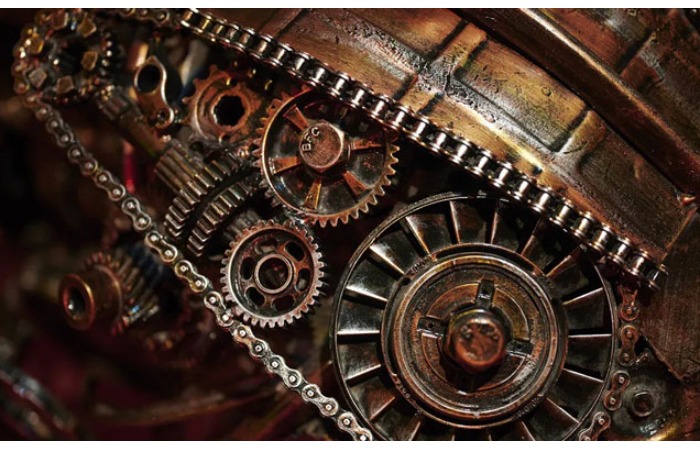
The Gear Advantage
As construction equipment evolves, gears and drive systems are taking centre stage, enabling higher power density, smoother operation, improved efficiency and enhanced machine performance in demanding conditions.
From excavators digging through rocky terrain and wheel loaders transporting heavy materials to cranes lifting massive structural components and crushers processing aggregates, construction equipment depends on the seamless transmission of power. At the heart of these operations lies a sophisticated network of gears, gearboxes, axles, transmissions and drive systems that convert power into precise, controlled and productive movement.
As construction projects become increasingly complex, equipment manufacturers are under pressure to deliver machines that offer higher productivity, greater fuel efficiency, lower operating costs and extended service life. Consequently, gears and drives are evolving from conventional mechanical components into highly engineered systems that directly influence equipment performance and lifecycle economics.
Advancements in material science, precision engineering, manufacturing technologies, electrification and digitalisation are transforming the power transmission landscape. For component manufacturers, the emphasis is increasingly on developing compact, lightweight, durable and intelligent solutions capable of meeting the changing requirements of original equipment manufacturers.
Powering demanding applications
Construction equipment operates under some of the most challenging industrial conditions. Heavy shock loads, continuous vibrations, abrasive dust, extreme temperatures and frequent changes in operating speeds place considerable stress on transmission components.
Different construction machines require different gearing arrangements. Planetary gear systems are widely used in excavator travel and slew drives, where compactness and high torque transmission are essential. Helical gears facilitate smoother power transmission, while bevel gears enable power transfer between intersecting shafts. Hypoid gears find applications in heavy-duty axles and differentials, while reduction gearboxes are integral to numerous material-handling and processing applications.
In excavators, final drives convert high-speed hydraulic motor rotation into the low-speed, high-torque movement required to propel the machine. In wheel loaders and backhoe loaders, transmission systems and axles must efficiently manage frequent directional changes, varying loads and uneven operating surfaces.
Similarly, cranes require precise motion control, while crushers, conveyors, concrete mixers and batching plants depend on gearboxes capable of sustaining demanding operational cycles.
The challenge for gear manufacturers is to achieve the right balance between torque capacity, operational efficiency, compactness and durability without significantly increasing the weight or cost of the equipment.
According to R Haridoss, CEO, Power Build, “A gearbox that is appropriately selected for the application can help equipment maintain dependable movement even when operating conditions become demanding.”
The company emphasises that selecting a gearbox solely on the basis of motor power can overlook several critical operating parameters. Starting torque, output speed, mounting arrangements, operating hours and duty cycles must all be considered when determining the appropriate drive solution.
With more than five decades of experience and over two million units installed worldwide, PowerBuild offers geared motors and industrial gearboxes through its Series-F, Series-M and Series-C ranges, catering to diverse speed, torque and mounting requirements across construction and material-handling applications.
The quest for higher power density
Higher power density has emerged as an important design consideration in modern construction equipment. OEMs increasingly require transmission systems capable of delivering greater torque within smaller installation spaces, allowing manufacturers to optimise machine architecture without compromising performance.
Planetary gear technology is particularly relevant in this context. By distributing loads across multiple planet gears, these systems can transmit substantial torque within a compact arrangement. This makes them suitable for excavators, cranes, compact construction machinery and heavy-duty off-highway vehicles.
Improvements in gear tooth geometry, advanced alloy steels, surface finishing and heat treatment processes are enabling manufacturers to develop components capable of withstanding higher mechanical and thermal stresses.
Technologies such as carburising, nitriding and induction hardening improve surface hardness and wear resistance while retaining the core strength required withstanding heavy loads. Precision grinding, meanwhile, helps minimise transmission errors, noise and vibration, contributing to smoother equipment operation.
The growing emphasis on noise, vibration and harshness (NVH) reduction is also encouraging manufacturers to optimise gear profiles, bearing arrangements and lubrication systems. Beyond improving operator comfort, these developments can help reduce premature component wear and improve overall machine reliability.
Domestic demand drives opportunities
India's infrastructure development and increasing mechanisation of construction activities are creating opportunities for manufacturers of gears, axles and transmission systems.
The performance of Carraro India, an independent Tier-I supplier of axles, transmission systems, gears and related components, provides an indication of the evolving domestic market.
During Q1 FY27, the company’s construction equipment business recorded revenue of Rs 2.26 billion, registering a four per cent year-on-year increase. Overall domestic revenue across its businesses grew by 26 per cent, while exports declined by 14 per cent amid geopolitical uncertainty and uneven international demand.
The backhoe loader segment remained particularly encouraging. While overall backhoe loader sales by Indian OEMs, including domestic sales and exports, increased by approximately 14 per cent during the quarter, Carraro's driveline sales to Indian OEMs grew by around 18 per cent.
Dr Balaji Gopalan, Managing Director, Carraro India, says, “In the construction-equipment segment, the export programme for TBH axles continues to progress as planned. We are also expanding our domestic TBH presence through new projects with Indian OEMs and the Indian operations of global OEMs. Carraro’s BHL sales to Indian OEMs continued to outperform the broader market.”
The company is expanding its telescopic-handler axle business through new development programmes and manufacturing investments. During FY26, Carraro India invested Rs 417 million towards new telescopic-handler axle production, high-performance agricultural transmissions and capacity expansion.
However, its standalone gears business remained subdued during Q1 FY27, highlighting the uneven demand conditions across different power transmission product categories.
Another significant investment in India's power transmission manufacturing ecosystem is being made by NORD Drivesystems. The company has broken ground on a new facility at RMK Industrial Park 3, near MIDC Talegaon Phase V, Pune, with an investment of Rs 4 billion. The facility is expected to double NORD India's gearbox and geared motor production capacity while introducing the manufacture of gears and related components.
The plant will serve domestic customers and support exports to NORD Group companies, including its headquarters near Hamburg, Germany. NORD India will become the group's first subsidiary outside Europe to manufacture gear components, strengthening India's role in its global production and sourcing network. Dhanraj Kalbhor, Managing Director, NORD Drivesystems, said the new facility would manufacture gears and similar components alongside gearboxes and motors. The investment is also expected to support greater localisation and deepen the company's contribution to the international supply chain.
Precision manufacturing takes centre stage
As equipment performance requirements become more demanding, investments in advanced gear manufacturing capabilities are becoming increasingly important.
Computer numerical control (CNC) machining, multi-axis machining centres, precision gear grinding, advanced metrology and computer-aided gear design are helping manufacturers achieve tighter tolerances, improved consistency and greater product reliability.
An example of India’s expanding precision engineering capabilities is Bevel Gears India's (BGI) recently inaugurated 70,000 sq ft manufacturing facility in Bengaluru, dedicated exclusively to aerospace and defence gearing.
While the facility caters specifically to aerospace applications, the investment reflects the broader advancement of India's gear manufacturing ecosystem. BGI also serves mining, steel, motorsport and industrial customers worldwide.
The facility houses advanced Gleason and Klingelnberg CNC bevel and hypoid gear grinding lines, five-axis machining centres and climate-controlled metrology infrastructure.
Mushtaq Jamal, Director – Engineering & Business Development, Bevel Gears India, says, “The facility has been designed around the requirements of flight-critical gearing, with dedicated manufacturing, inspection and quality infrastructure to support demanding tolerances, process control and complete traceability.”
Such investments demonstrate the growing sophistication of India's precision manufacturing sector. Similar engineering disciplines, including dimensional accuracy, tooth-contact analysis and material traceability, are increasingly relevant to heavy-duty construction equipment gearing.
Electrification reshapes drive systems
The transition towards electric and hybrid construction equipment is introducing new requirements for gears and transmission manufacturers.
Unlike conventional diesel engines, electric motors can deliver substantial torque from low speeds and operate across a wide speed range. This creates opportunities to simplify transmission architectures while introducing new challenges related to gear durability, noise, thermal management and system integration.
Electric drivetrains may incorporate compact reduction gearboxes, integrated motor-drive assemblies and electronically controlled transmission systems. The objective is to maximise energy utilisation while maintaining the power and reliability required for demanding off-highway applications.
Carraro India’s Rs 175 million e-transmission engineering project with Montra Electric, which had reached the prototype-order stage for field validation as reported in its Q1 FY27 results, illustrates the company's diversification towards emerging electric transmission technologies.
For gear manufacturers, electrification represents an opportunity to move beyond individual mechanical components and participate in the development of integrated drivetrain solutions.
The localisation of electrified powertrain technology is also gaining momentum in the automotive sector. Toyota Kirloskar Auto Parts (TKAP) has invested approximately Rs 4.60 billion in a new E-Drive manufacturing line at its Bidadi facility in Karnataka. The line adds an annual capacity of 200,000 units, taking TKAP’s total E-Drive production capacity to 360,000 units. The systems, recognised under the Government of India’s Production Linked Incentive (PLI) Scheme for Advanced Automotive Technology, are intended for Toyota’s hybrid electric vehicles.
Building on its fourth-generation E-Drive line commissioned in 2022, the expansion incorporates automation, advanced manufacturing processes and stringent quality controls. It also reflects the importance of local supplier development and specialised manufacturing capabilities as electrified powertrain systems become more widespread. Tabrez Ahmed, Managing Director, TKAP, said the new line would deepen the supplier ecosystem and support the development of a highly skilled workforce. While the investment is specific to automotive applications, it illustrates the scale of manufacturing capability and localisation that can support India’s wider transition towards electrified drive technologies.
From mechanical to intelligent drives
Digitalisation is adding another dimension to power transmission technology. Sensors, connectivity, edge computing and artificial intelligence (AI) are enabling drive systems to provide valuable insights into equipment health and operational performance.
Parameters such as vibration, temperature, rotational speed and motor loading can help identify abnormal operating conditions before they develop into significant mechanical failures.
ABB’s newly introduced Intelleqt motor reflects this transition towards intelligent industrial drive systems. The low-voltage motor incorporates factory-integrated sensing, edge computing and connectivity, enabling real-time operational insights from its first rotation.
According to ABB, early fault detection enabled by such technologies can reduce unplanned downtime by up to 50 per cent in industrial applications.
Stefan Floeck, President of ABB’s IEC Low Voltage Motors division, says, “The shift towards AI-driven operations is accelerating, yet most of the motors powering global industry do not generate data and remain invisible to the intelligence being built around them. ABB Intelleqt™ is a world first that opens a new chapter in motor development, transforming motors from mechanical equipment into sources of real-time intelligence.”
Although ABB's innovation addresses the broader industrial motor market, similar approaches could support predictive maintenance across construction-related applications such as crushers, conveyors, batching plants and material-handling systems.
Lifecycle economics and aftermarket potential
With rising equipment ownership costs and pressure on project margins, contractors are increasingly evaluating components based on their total cost of ownership rather than their initial purchase price.
Efficient gearboxes can help reduce energy losses, while appropriate lubrication, effective sealing and robust component design can extend service intervals. Early detection of gear wear and bearing deterioration can also help prevent costly secondary damage.
The aftermarket presents another significant opportunity for gear and drive manufacturers. Replacement gears, refurbished gearboxes, technical support, condition monitoring and reverse engineering of obsolete components can help equipment owners extend machine life and reduce capital expenditure.
As construction machinery becomes more technologically advanced, closer collaboration between component manufacturers, OEMs and fleet operators will be essential to ensure that drive systems deliver measurable improvements throughout the equipment lifecycle.
Driving the future
The future of gears and drives in construction equipment will be shaped by the convergence of precision engineering, higher power density, electrification, intelligent monitoring and application-specific design.
For Indian manufacturers, the opportunity extends beyond supplying conventional components to developing advanced, integrated power transmission solutions for domestic and international OEMs. Investments in research and development, manufacturing automation, testing infrastructure and engineering capabilities will be critical to strengthening global competitiveness.
Ultimately, the next generation of construction equipment will not be defined merely by how much power it generates, but by how efficiently, reliably and intelligently that power is transmitted.
Gears and drives, although largely concealed within machines, will remain central to this transformation, delivering the mechanical advantage that translates engineering innovation into on-site productivity.
 A-303, Navbharat
Estates,
Zakaria Bunder Road,
Sewri (West), Mumbai - 400 015,
Maharashtra, India
 +91-22-24193000
 Subscriber@ASAPPinfoGlobal.com