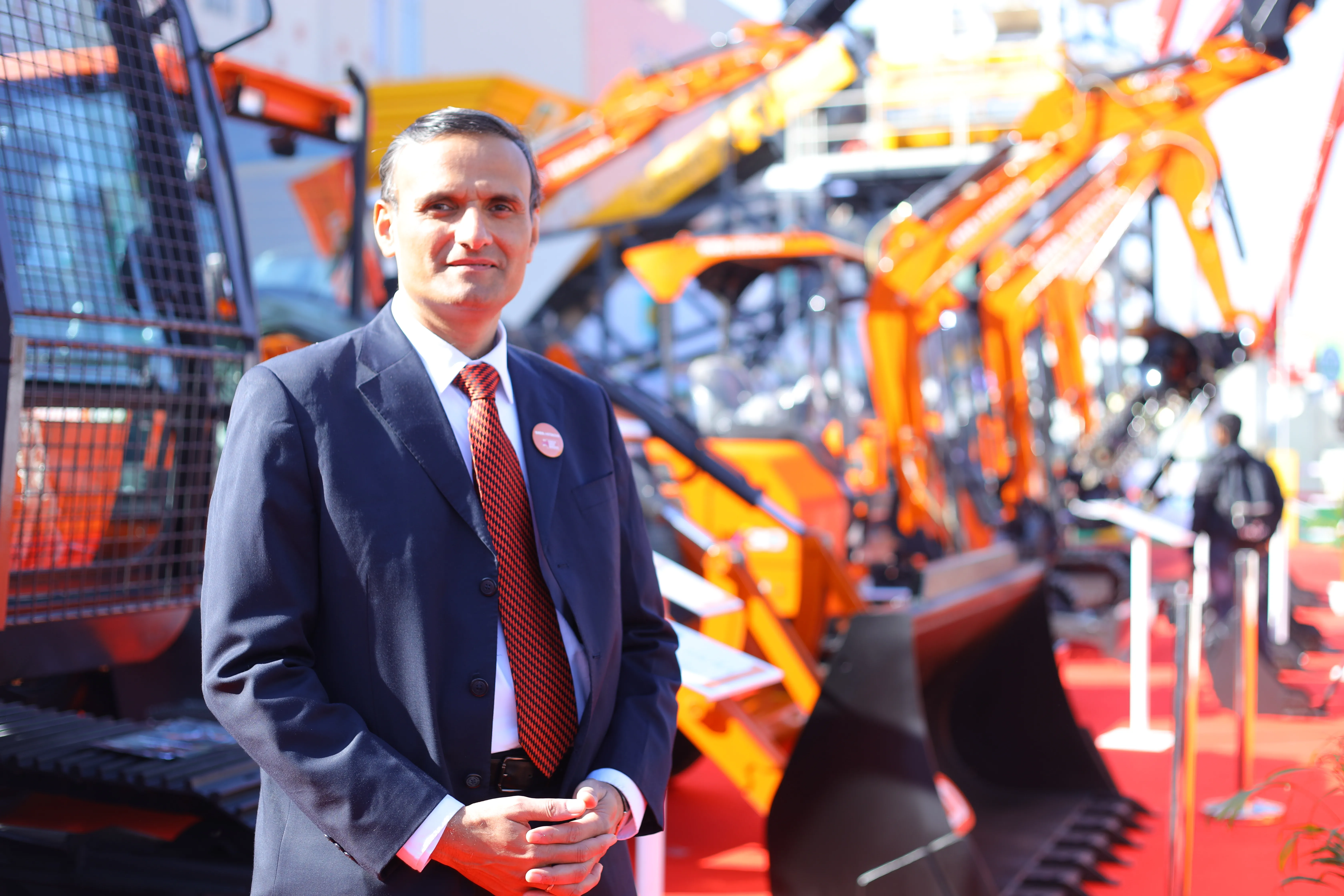
“It’s the fastest-growing segment among all excavators”
An Exclusive Interview with Siddharth Chaturvedi, GM – Marketing, Tata Hitachi Construction Machinery
What are the key products and attachments showcased by Tata Hitachi at bauma ConExpo?
We have showcased several products and attachments at the exhibition. These include the ZAXIS 40, the electric E33 and the NX30 Neo, along with a range of attachments for different applications.
Among the attachments are a bucket screener, bucket crusher and demolition attachments. The idea is to provide customers with greater flexibility by enabling machines to address a wider range of applications using different attachments.
What are the key features of the ZAXIS 40?
Two aspects are particularly important. We are offering a cabin as an optional attachment, and the machine also provides a longer reach.
These features make it suitable for applications such as unloading as well as general-purpose work. The machine is based on an established mini-excavator platform, which gives us a proven base to build upon.
How is the construction equipment industry transitioning towards cleaner technologies?
The transition is clearly visible. Electric machines are beginning to enter the market, while emission requirements are becoming progressively more stringent across the automotive and construction equipment sectors.
We have already seen tighter emission norms being introduced for diesel-powered wheeled equipment, and discussions are now taking place around similar requirements for excavators. This means the industry will have to continue moving towards cleaner and more efficient technologies.
How is the mini-excavator segment performing in India?
It is a booming business and, currently, the fastest-growing segment among excavators. One of the major factors driving this growth is the shortage of labour. At the same time, customers have higher productivity requirements. Mechanisation therefore becomes increasingly important because customers need to complete more work with fewer people.
How significantly is labour availability influencing equipment demand?
Both skilled and unskilled labour are becoming increasingly difficult to find, particularly for physically demanding work. For example, we recently spoke with a customer looking at using a mini excavator for demolition work because it was becoming difficult to find people willing to carry out manual demolition using hammers.
We have heard similar feedback from customers in other applications. An orchard owner, for instance, was looking at mechanisation for land-clearing activities because of difficulty in finding labour. These situations are increasing the relevance of compact equipment for applications that were traditionally labour-intensive.
What initiatives are you undertaking to improve operator skills?
We have two operator training centres where programmes are regularly conducted to develop operator skills. We also organise operator meets and field-level engagement programmes.
In addition, we have introduced an operator-connect initiative called Nirmata, which we plan to conduct at select locations. The intention is to build a stronger operator community rather than focus only on machine-operating skills.
There are several other issues relevant to operators, including health, certification and financial management. Through these programmes, we want to engage with operators on these broader aspects as well.
The construction equipment market has remained relatively flat in recent years. How has Tata Hitachi performed, and what is your outlook?
We have continued to grow, and our market numbers have been increasing. We remain positive about the industry’s longer-term prospects. There will always be temporary disruptions, whether due to oil-related developments in the Middle East or other external factors. However, we believe India’s underlying growth story remains intact.
Going forward, we would like to achieve growth of around 10 per cent. The industry as a whole is also looking towards a longer-term growth trajectory leading up to 2030.
 A-303, Navbharat
Estates,
Zakaria Bunder Road,
Sewri (West), Mumbai - 400 015,
Maharashtra, India
A-303, Navbharat
Estates,
Zakaria Bunder Road,
Sewri (West), Mumbai - 400 015,
Maharashtra, India +91-22-24193000
 Subscriber@ASAPPinfoGlobal.com