
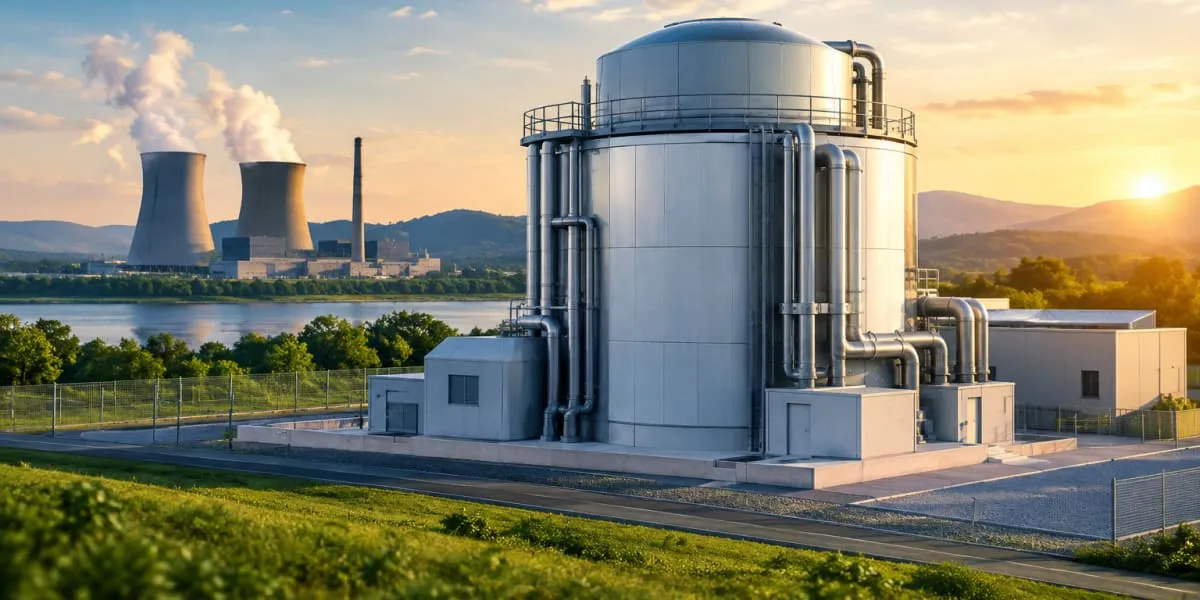
Andhra Pradesh Approves Small Modular Reactors as Thermal Alternative
The Andhra Pradesh government has approved the exploration of nuclear power generation using Small Modular Reactors (SMRs) as an alternative to thermal power. The decision was announced on November 20 by K Vijayanand, special chief secretary for Energy, following a request from Andhra Pradesh Power Generation Corporation (APGENCO).
The state will examine the establishment of SMR-based nuclear power plants at retiring thermal power units or other suitable locations. The initiative will proceed after the technology has stabilised, according to the government order approving the proposal.
Vijayanand said the private sector would be permitted to participate in Andhra Pradesh’s effort to establish SMR nuclear power plants. The government has therefore opened the exploration process to potential private participation while assessing locations and the suitability of the technology for the state’s energy requirements.
Unlike conventional nuclear power plants with capacity of around 700 MW(e), SMRs generally have capacity of about 300 MW(e), or approximately one-third of the output. Their smaller and modular design allows systems and components to be assembled in factories and transported as units for installation at selected sites.
The International Atomic Energy Agency (IAEA) describes SMRs as a low-carbon electricity option with a smaller physical footprint than conventional nuclear reactors. The technology uses nuclear fission to generate heat for power production and is designed to support more affordable construction, shorter building schedules and incremental deployment as electricity demand rises.
SMRs also require less fuel and typically need refuelling every three to seven years, compared with every one to two years for conventional nuclear plants. The IAEA has said some designs can operate for up to 30 years without refuelling, while SMRs can also be integrated with wind and solar generation in hybrid energy systems.
 A-303, Navbharat
Estates,
Zakaria Bunder Road,
Sewri (West), Mumbai - 400 015,
Maharashtra, India
 +91-22-24193000
 Subscriber@ASAPPinfoGlobal.com