Localisation will shape competitiveness
Siddharth Chaturvedi, General Manager – Marketing, Tata Hitachi Construction Machinery
What are the key products or technologies you are showcasing at bauma ConExpo India, and what makes them particularly relevant to the evolving needs of Indian customers?
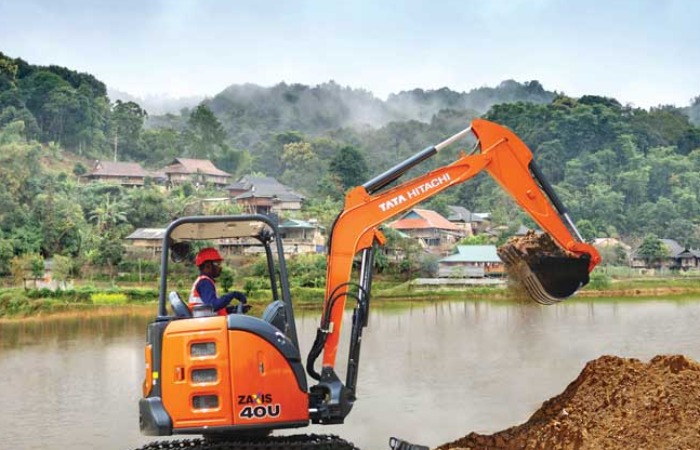
At bauma ConExpo India, we will showcase a comprehensive portfolio of our machines spanning mini excavators, infrastructure excavators, backhoe loaders and wheel loaders, along with a range of application-specific attachments designed for construction and infrastructure requirements.
The focus is not only on showcasing machines, but on demonstrating how our portfolio can address diverse applications and improve productivity at the job site. Customers today are looking for machines that offer the right balance of performance, fuel efficiency, versatility, reliability and operating economics. Our portfolio is therefore designed around these evolving requirements, with solutions that can deliver higher productivity while helping customers optimise their total cost of ownership.
The range of attachments further strengthens this proposition by enabling customers to configure machines for specific applications, making them more versatile and productive across different project requirements.
What major shifts are you seeing in customer demand—such as automation, digitalisation, fuel efficiency, alternative fuels and lower operating costs—and how is your product strategy responding to these trends?
Customer expectations are clearly moving beyond simply buying a machine. Today, customers are looking at the productivity and economics of the entire operation—including fuel consumption, machine utilisation, uptime, ease of operation, maintenance and after-sales support.
Digitalisation is playing an increasingly important role in this transition. Technologies that provide greater visibility into machine performance, utilisation and maintenance can help customers make more informed decisions and improve equipment uptime.
At the same time, fuel efficiency and lower operating costs remain extremely important considerations, particularly because construction equipment operates for long hours in demanding conditions. Our product strategy therefore focuses on delivering the right combination of performance, efficiency, reliability and lifecycle value.
We also see electrification and other alternative powertrain technologies developing progressively, particularly for applications where operating conditions and charging infrastructure make them viable. The approach has to be application-led rather than technology-led.
India is emerging as both a major construction equipment market and an export hub. What are your plans to expand manufacturing and exports from India over the next few years?
India has the potential to play a much larger role in the global construction equipment ecosystem, both as a large domestic market and as a manufacturing base.
For Tata Hitachi, our focus is on continuously strengthening our Indian manufacturing capabilities, localisation, supplier ecosystem and engineering capabilities so that we can serve the growing requirements of the domestic market while creating greater opportunities to participate in global supply chains.
Localisation is particularly important because it improves supply-chain resilience, enables greater cost competitiveness and allows products to be developed with a deeper understanding of Indian operating conditions.
We will continue to evaluate opportunities for exports based on market requirements, product competitiveness and the capabilities we build in India.
With global trade uncertainties, geopolitical tensions and changing tariff dynamics, how are you managing supply chains, costs and localisation to remain competitive?
In the current global environment, supply-chain resilience has become as important as cost competitiveness. Our approach is therefore focused on strengthening localisation, developing a robust supplier ecosystem and improving supply-chain agility.
Greater localisation gives us better control over lead times, costs and availability of critical components, while also reducing our exposure to global supply-chain disruptions. The objective is to create the right balance between global technology and local capability—leveraging the strengths of both while ensuring that our products remain competitive and relevant to Indian customers.
Ultimately, our focus remains on delivering dependable machines with competitive lifecycle economics, even as the external business environment continues to evolve.
What are your key business priorities for the Indian market over the next two to three years, and where do you see the biggest growth opportunities?
Over the next two to three years, our priorities will revolve around customer value, product portfolio expansion, localisation, technology, aftermarket support and operational excellence.
We see significant opportunities arising from India have continued focus on infrastructure development – including roads, highways, railways, urban infrastructure, water management, mining, renewable energy and industrial development. These sectors will require a diverse range of equipment and application-specific solutions.
Another important opportunity is the increasing demand for machines that offer better productivity and lower lifecycle costs. This is where our broader portfolio across excavators, backhoe loaders, wheel loaders and attachments give us an opportunity to address customers across multiple applications.
We will also continue to strengthen our aftermarket and service ecosystem because, ultimately, the value of a construction machine is determined not just by what it delivers on the day of purchase, but by how reliably and productively it performs throughout its operating life.
Our larger objective is to remain a trusted partner in India’s infrastructure journey—bringing together reliable products, technology, strong service support and a deep understanding of customer applications.
 A-303, Navbharat
Estates,
Zakaria Bunder Road,
Sewri (West), Mumbai - 400 015,
Maharashtra, India
A-303, Navbharat
Estates,
Zakaria Bunder Road,
Sewri (West), Mumbai - 400 015,
Maharashtra, India +91-22-24193000
 Subscriber@ASAPPinfoGlobal.com