
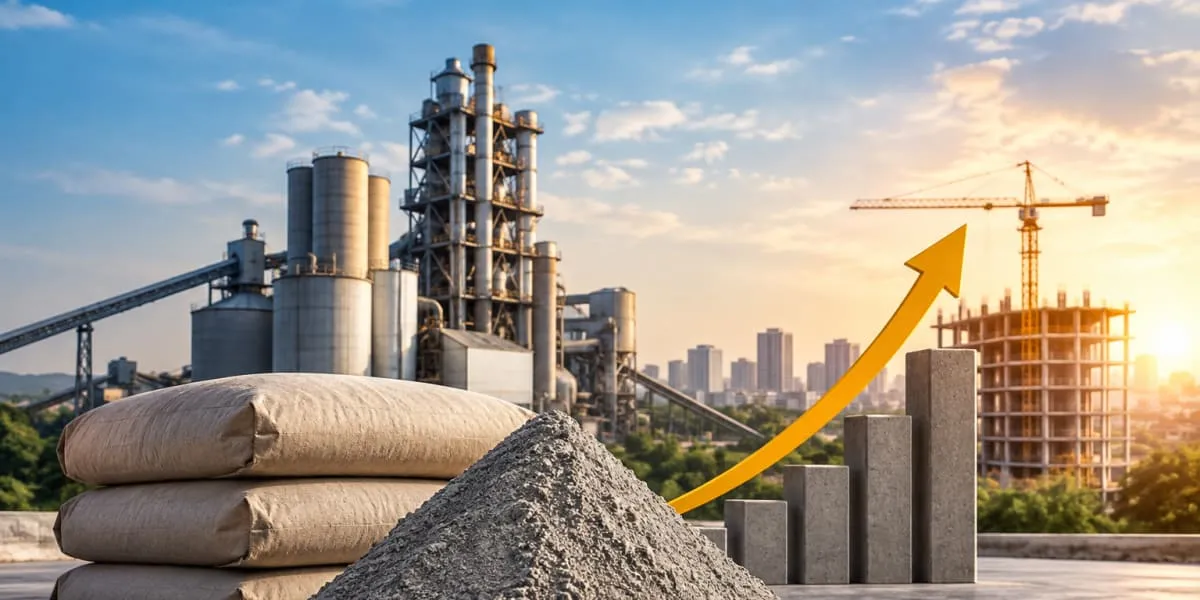
Shree Cement to Cross 100 MTPA Capacity in 3-4 Years
Shree Cement expects to cross 100 mn tonnes per annum (MTPA) of production capacity within the next three to four years, supported by expansion and demand from India’s infrastructure and housing sectors. Chairman Hari Mohan Bangur said the company is targeting a compound annual growth rate (CAGR) of 9-10 per cent over the next six to seven years, compared with estimated growth of 7-8 per cent for the Indian cement industry.
The company plans to reach 80 MTPA within the next two years. Earlier this month, it announced an investment of Rs. 70 bn to establish cement plants in Andhra Pradesh. Shree Cement currently has installed production capacity of about 75 MTPA, including manufacturing facilities in the UAE.
Shree Cement is also investing Rs. 35-40 bn in plants at Kutch in Gujarat and Meghalaya. Most of this expenditure is being funded through internal reserves, according to Bangur. The company is expanding its ready-mix concrete (RMC) operations as an adjacent business and currently operates about 40 RMC plants.
The number of RMC plants is expected to rise to 60-80 over the next 15-18 months. Monthly RMC production capacity, currently 100,000 cubic metres, is planned to increase to 200,000 cubic metres during the same period. The company does not currently plan to diversify into other building-material categories such as wires, cables and paints, and is instead focusing on cement and RMC.
Bangur said cement producers could sustain margins of around 15-20 per cent on sales, while premium products offered stronger realisations and profitability opportunities. Individual homebuilders were more willing to pay for quality, whereas large developers generally remained focused on value for money. About 60 per cent of Shree Cement’s energy requirement is met through renewable sources and waste heat recovery, including solar and wind power.
India’s annual cement consumption has grown from about 40 mn tonnes to approximately 450-500 mn tonnes, reflecting broader development. Bangur said continuing infrastructure and housing activity, supported by economic growth of 6-8 per cent, would sustain long-term demand.
 A-303, Navbharat
Estates,
Zakaria Bunder Road,
Sewri (West), Mumbai - 400 015,
Maharashtra, India
 +91-22-24193000
 Subscriber@ASAPPinfoGlobal.com