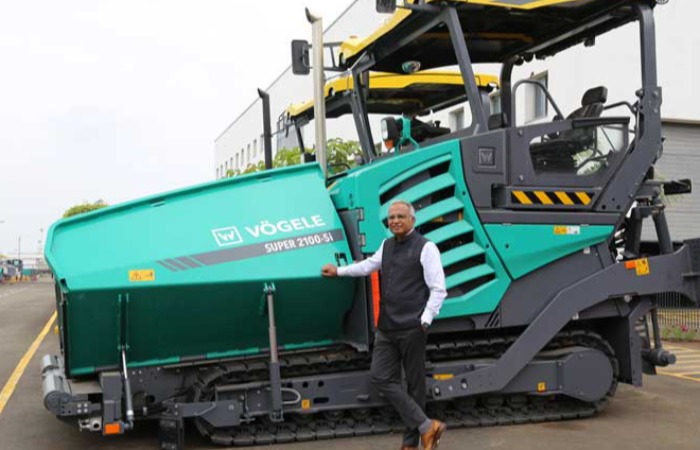
The future of road construction is digital
Ramesh Palagiri, MD and CEO, Wirtgen India, speaks on how road construction equipment will evolve to meet future infrastructure requirements.
As India pursues its Vision 2047 infrastructure goals, what role do you see road construction equipment playing in transforming the countrys road and highway network?
Road construction equipment will play a pivotal role in enabling Indias transition to a modern, high-quality, and resilient road network under Vision 2047. Advanced, highly mechanised equipment ensures faster project execution, precision, and consistency, which are critical for building world-class highways on a scale.
Technologies such as intelligent paving, recycling solutions, and automated compaction are helping improve construction quality while reducing resource consumption and emissions. Additionally, digital integration and telematics enhance productivity and maintenance planning.
At Wirtgen India, we believe that widespread adoption of such technologies will be key to delivering durable, sustainable, and future-ready infrastructure.
What are the key trends currently shaping demand for road construction equipment in India, and how do you expect these trends to evolve over the next decade?
Demand for road construction equipment in India is being driven by increased public infrastructure spending, expansion of expressways, and focus on faster project execution. There is a clear shift towards higher mechanisation, larger-capacity machines, and advanced technologies that improve productivity and quality. Sustainability is another key trend, with growing adoption of recycling solutions and fuel-efficient equipment.
Over the next decade, we expect accelerated adoption of digitalisation, automation, and intelligent machines, along with stricter quality and environmental standards. This will drive demand for technology-led, sustainable, and high-performance equipment solutions across the sector.
How are technologies such as telematics, machine control, automation, AI and connected job sites improving productivity, quality and project execution?
Technologies such as telematics, machine control, automation, and AI are transforming road construction by enabling data-driven, precise, and efficient execution. Telematics systems provide real-time insights into machine performance, utilisation, and fuel efficiency, helping reduce downtime through predictive maintenance.
Machine control and automation ensure high levels of accuracy and consistency, minimising human error and rework, which directly enhances quality. Connected job sites allow seamless coordination between equipment, operators, and project managers, improving overall productivity.
At Wirtgen India, we see these technologies driving faster execution, better resource optimisation, and superior lifecycle performance, paving the way for smarter infrastructure delivery.
Sustainability is becoming increasingly important in infrastructure development. How are equipment manufacturers supporting greener road construction through technology, fuel efficiency and recycling solutions?
Sustainability is at the core of modern road construction, and equipment manufacturers are enabling this shift through innovative, resource-efficient technologies. Solutions such as cold milling, in-situ cold recycling and warm mix asphalt technologies significantly reduce the consumption of virgin materials, fuel usage, and carbon emissions.
Advanced machines are now designed for higher fuel efficiency and lower emissions, aligning with stricter environmental norms. Additionally, intelligent systems optimise material usage and minimise waste during construction and also help monitor machine health and predictive maintenance.
At Wirtgen India, we believe that widespread adoption of such sustainable solutions not only reduces environmental impact but also enhances cost efficiency and long-term infrastructure performance.
Contractors today are under pressure to deliver projects faster while controlling costs. What innovations are helping improve equipment uptime, operational efficiency and lifecycle economics?
Contractors today are increasingly leveraging telematics, predictive maintenance, and digital fleet management systems to maximise equipment uptime and efficiency. Real-time data on machine performance enables proactive service, reducing unplanned breakdowns and costly delays.
In addition, fuel-efficient engines, optimised hydraulics, and intelligent machine controls help lower operating costs while improving productivity. Automation also reduces dependency on manual intervention, ensuring consistent output.
At Wirtgen India, we emphasise integrated solutions combining advanced equipment with digital support and service networks, enabling contractors to enhance utilisation, control costs, and achieve superior lifecycle economics.
Looking ahead to 2047, what will the ideal road construction project site look like, and how will road equipment evolve to meet future infrastructure requirements?
By 2047, the ideal road construction site will be fully digital, connected, and highly automated, driven by real-time data and seamless coordination. Equipment will be intelligent and self-optimising, with advanced machine control, AI-driven insights, and minimal manual intervention, ensuring precision and consistent quality.
Sustainability will be central, with widespread use of recycling technologies, low-emission machines, and energy-efficient processes.
At Wirtgen India, we foresee equipment evolving into smart, integrated solutions that enhance productivity, ensure superior lifecycle performance, and enable faster, safer, and environmentally responsible infrastructure development.
 A-303, Navbharat
Estates,
Zakaria Bunder Road,
Sewri (West), Mumbai - 400 015,
Maharashtra, India
A-303, Navbharat
Estates,
Zakaria Bunder Road,
Sewri (West), Mumbai - 400 015,
Maharashtra, India +91-22-24193000
 Subscriber@ASAPPinfoGlobal.com