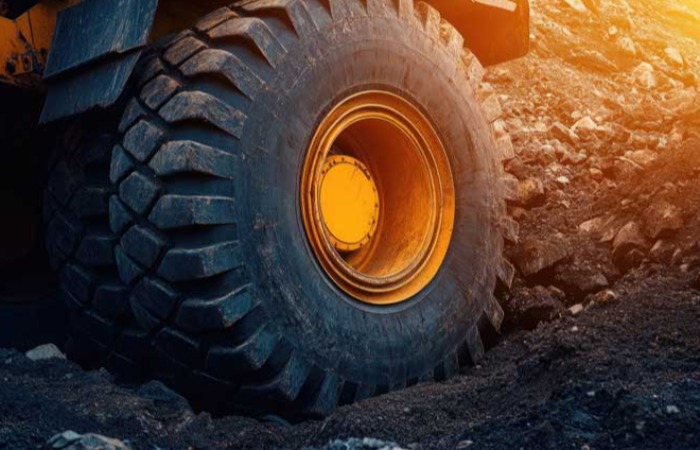
Under Pressure
For decades, tyres were often treated as a relatively straightforward replacement item in the construction equipment ecosystem. Specify the right size, fit the tyre, maintain the pressure and replace it when the tread wears out. But that equation is changing rapidly.
India’s construction, infrastructure, mining and material-handling sectors are deploying equipment that is larger, more powerful and increasingly utilised for longer operating cycles. Machines are expected to move greater loads, travel faster, work across increasingly varied terrains and deliver higher productivity with less downtime. In such an environment, the tyre is no longer simply the component connecting the machine to the ground. It has become a critical determinant of machine availability, fuel consumption, safety and operating cost.
“Equipment is getting bigger; tyres must keep pace,” says Farid Ahmed, Head – Product Management (OHT), BKT. His observation captures the fundamental shift taking place in the off-the-road (OTR) tyre market.
The pressure on tyre manufacturers is coming from multiple directions. Construction projects are becoming larger and more time-sensitive. Mining equipment is operating under higher loads and longer duty cycles. Compact machines such as skid steers, telehandlers and aerial work platforms are finding wider application in urban and industrial environments. At the same time, electrification and digitalisation are introducing an entirely new set of requirements.
The result is a tyre market increasingly defined by application engineering, uptime and total cost of ownership (TCO) rather than simply price and initial tread life.
When uptime becomes the metric
The economics of an OTR tyre are fundamentally different from those of a conventional road tyre. A tyre failure on a passenger vehicle is an inconvenience. On a wheel loader working in a quarry, a mining LHD operating underground or a material-handling machine running multiple shifts, it can bring an entire operation to a halt. This is why uptime has become one of the strongest drivers of tyre innovation.
“Uptime is driving the next generation of OTR tyres,” says Shyam Gyanani, Founder and MD, Trident International. According to him, tyre and fuel costs are among the top three operating costs for industrial equipment, making TCO increasingly important to fleet owners.
The focus is consequently shifting towards solutions that minimise tyre-related stoppages. Trident, for instance, is developing application-specific solid, foam-filled and puncture-proof solutions for construction, aerial access, material handling and underground mining. Its TRAXTER severe-duty solid tyres are designed for applications such as wheel loaders, skid steers, backhoe loaders and telehandlers working in environments including demolition, scrap processing and slag handling.
The objective is not merely to make tyres last longer, but to eliminate a failure mode altogether.
“We focus on developing tyre and track solutions that are 100 per cent puncture proof, ensuring no tyre-related equipment downtime and operator idle time and improving safety and productivity,” Gyanani explains.
This is particularly relevant in harsh applications where punctures and sidewall damage can be frequent. Solid tyres, foam-filled assemblies and specialised constructions are therefore finding a stronger place alongside conventional pneumatic tyres.
The growth of aerial work platforms and boom lifts illustrates how application-specific tyre development is expanding beyond traditional earthmoving. JK Tyre’s OTR portfolio, for example, includes SKY GRIP tyres developed for aerial work platforms and boom lifts, where stability and traction are especially important when machines are operating at height. The company has also developed products for backhoe loaders, wheel loaders and underground mining applications.
Radial transition gathers pace
One of the most significant changes underway in the Indian OTR market is the movement from conventional bias-ply tyres towards radial construction.
India has historically been a bias-tyre-dominated market, but the economics of modern equipment are increasingly favouring radials. Lower rolling resistance, improved heat dissipation, longer tread life, better traction and stability can translate into measurable gains over the tyre’s operating life.
Dyutiman Chattopadhyay, Chief Technology Officer, Yokohama-ATG, points to this transition as a defining trend. “This technology is rapidly emerging as the preferred choice due to its performance and durability advantages,” he says.
The shift is being supported by the changing nature of equipment itself. As horsepower rises and machines carry heavier loads, tyres are exposed to greater mechanical and thermal stresses. The ability to dissipate heat and maintain performance over extended duty cycles becomes increasingly important.
BKT is responding with an expanding all-steel radial portfolio. Ahmed says the company’s radial tyres are engineered to provide “uniform wear and enhanced heat dissipation”, helping reduce downtime and extend equipment service life.
The technology is not without challenges. Radial tyres generally carry a higher upfront cost than bias tyres, while their flexible sidewalls can be more vulnerable in extremely harsh operating conditions. Awareness of lifecycle economics also varies across markets. Yet as fleets become more professional and customers increasingly evaluate cost per operating hour, the higher initial investment can be weighed against longer service life, fuel savings and reduced downtime.
The movement is already visible in product development. Yokohama-ATG, for instance, has introduced all-steel radial solutions such as the LDSR 500 for heavy-duty wheel loaders and dozers and the RTSR 300 for rigid dump trucks. The products combine deeper treads, specialised compounds and application-specific designs aimed at demanding operating conditions.
From one tyre to the right tyre
Perhaps the biggest change in OTR tyre engineering is that there is increasingly no such thing as a truly “general-purpose” tyre. A wheel loader operating in a quarry, a skid steer working on a construction site, a forklift running continuously on concrete, and an underground mining LHD may all require completely different tyre characteristics.
The tread pattern, compound, casing construction, load capacity and heat-management characteristics have to be matched to the application.
“Product development begins with a detailed understanding of the machine, terrain and operating conditions,” says Ahmed. “Tread patterns, compounds and construction types are developed to achieve the required balance of traction, durability, rolling resistance and heat management.”
That application-led approach is becoming increasingly important as equipment itself becomes more specialised.
Trident, for example, has developed different compounds and tread configurations for hard-rock mining, soft-rock mining and industrial applications. Its forklift tyres use a three-lug tread with a continuous centre pattern designed to provide smoother operation, reduced vibration and lower rolling resistance. For loaders working in steel plants, glass factories and recycling yards, the company uses extra-deep L5 tread designs and highly wear-resistant compounds.
Similarly, JK Tyre’s recent OTR portfolio expansion reflects the growing segmentation of the market, with different products addressing aerial platforms, backhoe loaders, wheel loaders and underground mining.
The message from manufacturers is clear: tyre selection is becoming an engineering decision rather than a procurement decision.
The heat is on
As equipment works harder and faster, thermal management is emerging as another critical area of development. Machines working continuously over multiple shifts generate considerable heat within the tyre. Excessive heat build-up can accelerate compound degradation, affect structural integrity and ultimately shorten tyre life.
This is driving manufacturers towards specialised compounds, improved casing designs and more advanced testing.
Trident has taken this a step further with its SMARTIRE system, which uses integrated sensors to monitor internal rubber-core temperatures and duty cycles in real time. The objective is to identify operating conditions that could result in thermal compound breakdown during continuous fleet operations.
Testing is also becoming more sophisticated. Trident conducts laboratory tests for abrasion, tear resistance and fatigue before subjecting new tyres and compounds to in-house test rigs to assess heat build-up, load capacity and construction performance. Products are then tested on equipment fleets to simulate actual operating conditions.
The approach reflects a wider shift in the industry: tyre development is increasingly being driven by data, simulation and field validation rather than only laboratory specifications.
India moves up the value chain
India is also playing a larger role in the global OTR tyre industry. The country is no longer simply a low-cost manufacturing base. Tyre companies are increasingly investing in product development, testing, automation and specialised manufacturing capabilities to serve both the domestic market and global customers.
CEAT Specialty Tyres, for example, has significantly increased its R&D investment, including a new Mumbai facility with an investment of close to $40 million. Amit Tolani, Chief Executive, CEAT Specialty Tyres, says the facility is focused on developing and testing tyres for next-generation equipment and Indian operating conditions.
“As construction equipment horsepower continues to increase, tyre performance requirements are also rising. It is therefore essential to continuously update products to handle heavier applications and more demanding operating conditions,” he says.
BKT has taken an equally global approach. Its Indian manufacturing facilities supply tyres to more than 160 countries, while its Bhuj facility combines manufacturing with R&D, testing and advanced compounding capabilities.
Trident, meanwhile, manufactures its solid tyres and rubber tracks at its joint-venture facility in Jejuri near Pune, with more than 75 per cent of production exported to over 35 countries. The company plans to double capacity over the next 18-24 months.
This export orientation is significant because it exposes Indian manufacturers to global equipment requirements and demanding operating conditions. Product development is consequently being driven not only by what Indian fleets require today, but by what global OEMs and operators will need tomorrow.
Electrification changes the equation
The next disruption could come from electric construction and material-handling equipment. Electrification brings new considerations for tyres because electric machines can have different torque characteristics, weight distribution and operating patterns compared with conventional diesel equipment. Rolling resistance becomes particularly important because every efficiency gain can contribute to extending operating range or reducing energy consumption.
BKT has already introduced e-ready tyres for electric equipment and is developing additional sizes with reduced rolling resistance.
“As machinery evolves, performance requirements for tyres continue to advance, particularly with the introduction of electric and hybrid equipment,” notes the industry.
The transition is still at an early stage across heavy construction and mining, but tyre manufacturers are already preparing for it. The tyre of the future will have to work not only with the machine’s mechanical characteristics but also with its energy architecture.
Smart tyres, smarter fleets
Digitalisation could ultimately transform how tyres are managed. Connected equipment is already enabling fleet operators to monitor machine utilisation, fuel consumption, location and maintenance requirements. Tyres are increasingly becoming part of this data ecosystem.
Temperature, pressure, duty cycle, wear and operating conditions can potentially be monitored to identify abnormal patterns before they result in a failure.
This represents a major opportunity for fleet owners. Instead of replacing tyres based on fixed schedules or reacting to failures, operators can move towards condition-based maintenance.
The implications go beyond tyres. Predictive tyre maintenance can improve machine availability, operator safety, fuel efficiency and overall fleet productivity.
India’s infrastructure build-out is creating a favourable long-term environment for the OTR tyre industry. Roads, bridges, ports, mining, urban infrastructure and industrial projects are all driving demand for earthmoving and material-handling equipment. But the opportunity comes with a higher performance threshold.
Machines are getting bigger. Projects are getting more demanding. Operating cycles are getting longer. Equipment owners are becoming more conscious of cost per hour rather than simply purchase price. That is changing what customers expect from the black rubber beneath their machines.
The next generation of OTR tyres will have to be tougher, smarter and more application-specific. Radial construction will gain ground. Puncture-proof and solid solutions will expand in severe-duty applications. Sensors will increasingly bring tyres into the connected-equipment ecosystem. Electrification will create new rolling-resistance and durability requirements. And manufacturers will continue to invest in compounds, testing, automation and application engineering.
The direction of travel is perhaps best summed up by Ahmed: “As the equipment across segments becomes larger, powerful and capable of handling higher loads, tyre performance is becoming increasingly important to overall machine productivity, safety and efficiency.”
The tyre industry is therefore no longer simply following the evolution of construction equipment. It is becoming an active enabler of it.
As India builds bigger, moves heavier and works longer, the real measure of an OTR tyre will increasingly be what happens beyond the purchase price: how many productive hours it delivers, how reliably it performs and how much it contributes to the machine’s bottom line.
 A-303, Navbharat
Estates,
Zakaria Bunder Road,
Sewri (West), Mumbai - 400 015,
Maharashtra, India
A-303, Navbharat
Estates,
Zakaria Bunder Road,
Sewri (West), Mumbai - 400 015,
Maharashtra, India +91-22-24193000
 Subscriber@ASAPPinfoGlobal.com