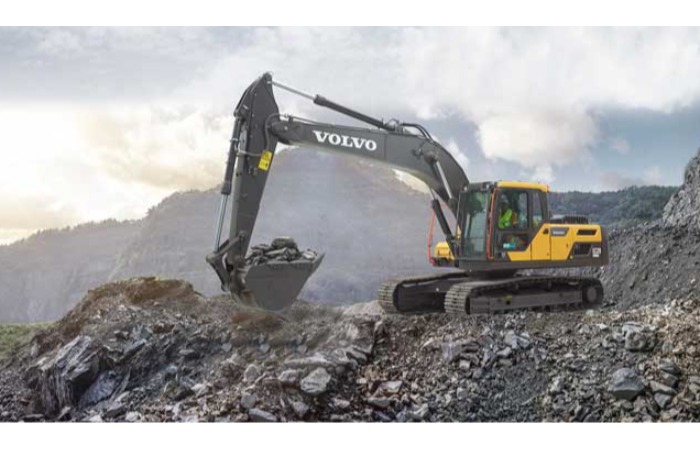
Technology is reshaping excavator demand
Dimitrov Krishnan, Managing Director, Volvo Construction Equipment India, discusses shifting customer priorities, sustainable technologies and the evolving role of excavators in Indias infrastructure growth.

The 20“22 tonne segment continues to dominate the Indian hydraulic excavator market. What are the key factors driving the strong demand for this category across infrastructure, mining, and urban construction applications?
The 20“22 tonne excavator segment is popular in India because it offers the right balance of productivity, versatility and operating cost. It is powerful enough for demanding applications, while still being flexible for use across infrastructure, urban construction, quarrying, utilities and medium-scale mining jobs.
For contractors, this class of excavators allows for increased versatility through the ability to complete all types of excavation-related jobs - including loading and trenching - by using the same machine and attachments.
In a cost-conscious market like India, customers prefer machines that deliver strong output, fuel efficiency, easy maintenance and better lifecycle value.
How is customer expectation evolving in the hydraulic excavator market in India, particularly in areas such as fuel efficiency, machine uptime, lifecycle costs, telematics, and operator comfort?
Customer expectations today extend beyond just the initial purchase price to include an analysis of the total cost of owning the product. In addition to initial price, todays customers also consider factors such as how much fuel they will use in the life of the product and how often it will be out of service.
Fuel efficiency is a critical factor when it comes to profit. Uptime is another important factor as well, because when a machine is not in use, it can cause delays in completing jobs and can increase costs. Customers are becoming more receptive to using telematics technologies to understand their fuel usage, machine health, idle time and service action requirements.
With the current shortage of trained operators in the construction industry, the comfort level of operators continues to be of great importance.
In your view, what are the most significant trends currently shaping the Indian hydraulic excavator industry, and how do you see the market evolving over the next three to five years?
The Indian hydraulic excavator industry is being influenced by increased infrastructure development, increased mechanization of construction processes, improved fuel efficiency, use of advanced technology and demand for lower overall lifecycle costs. Demand will also continue to be driven by the need for road construction; rail construction; mining; agriculture; water-based construction; and development of urban areas and construction of world class industrial type facilities.
It will be very important to focus on value based selling to customers who will not only consider the price of the machine but also; productivity, up time, service support, fuel savings, telematics and resale value. The 20 tonne class will continue to be of major significance because it provides the greatest range of applications throughout all of India.
Contractors today are increasingly looking for higher machine utilisation and operational flexibility. How are attachments, advanced hydraulics, and smart machine technologies helping excavators become multi-application machines?
Contractors today want excavators that can do more than one job. Attachments are helping convert excavators from digging machines into multi-application machines for road construction, urban infrastructure, irrigation, mining and quarrying, utilities, demolition, waste recycling and material handling.
Attachments such as rock breakers, quick couplers, vibro rippers, pile drivers, drum cutters, augers, bucket crushers, compactors, grabs, long-reach arms and material handling booms allow the same machine to be used across different applications.
Advanced hydraulics help deliver the right flow, pressure and control for these attachments, improving productivity and precision. Smart technologies and telematics further help customers monitor utilisation, fuel use, idle time and service requirements.
With rising fuel costs and pressure on project profitability, how important have fuel-efficient technologies and intelligent hydraulic systems become in influencing customer buying decisions?
One major factor being considered in purchasing excavators today is fuel efficiency. When excavators are used in applications with a lot of utilisation, fuel can be the largest operating expense for the machines, so every little bit saved can make a difference over the life of the excavator.
Customers are now looking at cost per hour and cost per tonne, not just the upfront price. Intelligent hydraulic systems, efficient engines, work modes, auto-idling and better engine-hydraulic matching help reduce fuel wastage while maintaining productivity.
For customers now fuel efficiency is considered to be a requirement of doing business not just an attribute of the product.
The rental market is playing an increasingly important role in equipment deployment across India. How is the growing rental ecosystem influencing excavator design, technology adoption, and purchasing patterns?
The rental market is extending due to contractors wanting flexibility along with a better capital efficiency. Many customers would rather have access to equipment based on project length and work load, than own every unit of equipment.
This is driving demand for versatile, durable, fuel efficient, easily maintained and used by multiple operators and job sites excavators. In addition, rental fleet owners appreciate telematics for help tracking machine location, utilisation, fuel costs/usage, idle time & service requirements.
With growth in rental there is a greater emphasis on machine uptime, lifecycle cost, ease of service and resale value in purchase decisions.
Sustainability and digitalisation are becoming important themes globally. What is your companys approach towards connected excavators, predictive maintenance, hybrid/electric machines, and low-emission technologies for the Indian market?
Our strategy of helping Indian customers become more sustainable is achieved through practical & easy to understand, with immediate results largely from fuel-efficient machines, intelligent hydraulic equipment, connected machines, better maintenance and operator training.
Using telematics gives our customers visibility into fuel consumption, machine health, productivity, idling, and service requirements. This enables and supports planned/predictive maintenance to maximise uptime and help reduce operating costs.
The transition to electric machines will be done based upon the suitability of the application. Electric machines will be practical and suitable where appropriate charging infrastructure is available, duty cycle and operating costs make sense. As it relates to larger excavators, this will be a gradual change.
 A-303, Navbharat
Estates,
Zakaria Bunder Road,
Sewri (West), Mumbai - 400 015,
Maharashtra, India
A-303, Navbharat
Estates,
Zakaria Bunder Road,
Sewri (West), Mumbai - 400 015,
Maharashtra, India +91-22-24193000
 Subscriber@ASAPPinfoGlobal.com