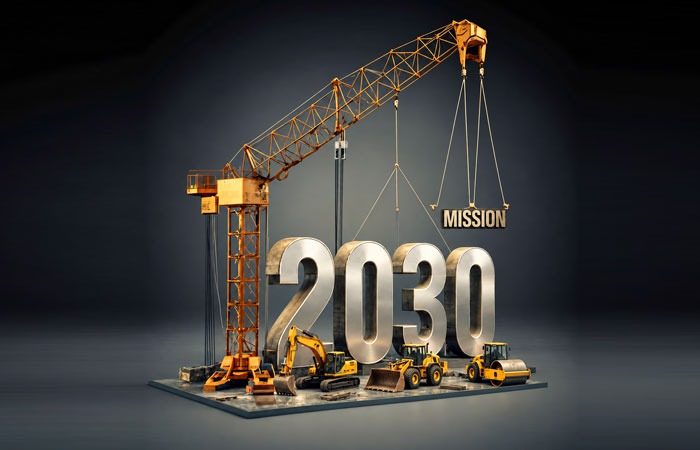
MISSION 2030
India has emerged as the world’s third-largest construction equipment market, supported by an expanding manufacturing base, infrastructure investment and growing exports. But the next leap will demand far more than production capacity. As the industry sets its sights on 2030, manufacturing excellence, indigenous technology, global competitiveness, sustainability and a stronger equipment ecosystem will determine whether India can transform from a major market into a world-class manufacturing and innovation powerhouse.
India's construction equipment industry stands at a defining crossroads. On one side lies the remarkable progress of the past decade, during which the country has built a substantial manufacturing base, attracted global equipment manufacturers and developed an extensive network of domestic suppliers. On the other lies a considerably more ambitious opportunity: to establish India as one of the world’s leading centres for construction equipment manufacturing, engineering, innovation and exports.
The foundations are already visible. India’s infrastructure transformation, spanning expressways, railways, airports, ports, industrial corridors, urban transportation and mining, has generated sustained demand for equipment across multiple categories. Backhoe loaders, hydraulic excavators, cranes, concrete machinery, compactors, crushers and material handling equipment have become indispensable to the country’s infrastructure ambitions.
Yet the industry’s future will be determined by something more significant than the volume of machines deployed across Indian construction sites.
The central question is whether India can move beyond manufacturing predominantly for domestic consumption and establish itself as a globally competitive source of equipment, components and technologies.
The latest industry figures reveal both the promise and the complexity of this transition. According to the Indian Construction Equipment Manufacturers’ Association (ICEMA), overall construction equipment sales declined by approximately 2 per cent to 136,995 units in FY2025-26, compared with 140,191 units in the previous financial year. Domestic demand came under pressure from slower infrastructure execution, project delays, rising equipment costs and financing constraints.
Exports, however, provided a striking counterpoint, increasing by 31.5 per cent to 17,394 units. The growth reflects expanding international acceptance of India-manufactured equipment and suggests that overseas markets could become an increasingly important pillar of the industry's future.
India remains the world’s third-largest construction equipment market. ICEMA’s more recent assessment estimates the market at approximately $10 billion in FY2024-25, with the potential to reach $14.76 billion by 2030 at a compound annual growth rate of 8.3 per cent. Its earlier, broader Vision Plan 2030 articulated the ambition of building an approximately $25 billion industry and positioning India as the world's second-largest construction equipment market.
These projections are not directly interchangeable, given their different assumptions and market definitions. Nevertheless, they underline the scale of the opportunity.
The challenge now is to transform domestic manufacturing strength into sustained international competitiveness.
The manufacturing imperative
India has already achieved considerable progress in domestic equipment production. More than 95 per cent of construction equipment sold in the country is manufactured locally. In several categories, localisation has advanced substantially, supported by investments from domestic companies and multinational OEMs.
However, manufacturing scale and manufacturing competitiveness are not synonymous.
Global leadership requires companies to deliver consistent quality, productivity, reliability and technological sophistication while remaining competitive on costs. It also requires an industrial ecosystem capable of designing, developing, testing and manufacturing increasingly complex components domestically.
Hitesh Agarwal, Chief Operating Officer, Action Construction Equipment (ACE), believes manufacturing excellence and deeper localisation will be among the most important determinants of India's progress towards 2030.
For Agarwal, the industry must move beyond producing equipment primarily for domestic consumption and develop systems that consistently meet international expectations around reliability, operator safety, emissions, fuel efficiency, lifecycle costs and after-sales support.
He emphasises that quality must be integrated into every stage of manufacturing, rather than treated as an inspection activity at the end of production.
This approach becomes especially important as Indian manufacturers expand their presence in developed and emerging international markets. A competitive purchase price may attract initial customer interest, but consistent equipment performance determines whether a manufacturer can retain that customer.
Sanjeev Bajaj, Chief Officer, Construction Equipment Business, Escorts Kubota, similarly identifies manufacturing excellence as the foundation of global competitiveness. He argues that India's next phase of indigenisation must focus on critical components, supplier competencies and stronger manufacturing processes.
At Escorts Kubota, the adoption of the Kubota Production System reflects the emphasis on quality, cost and delivery, supported by continuous efforts to eliminate waste and improve productivity.
For Bajaj, localisation must deliver internationally competitive products rather than simply increase domestic sourcing.
That distinction is crucial. An imported component replaced by a locally manufactured alternative creates limited long-term value if it compromises reliability, durability or performance. Genuine localisation must strengthen the manufacturer's ability to compete internationally.
The implications extend well beyond OEM facilities.
Neeraj Kulkarni, Regional Business Line Manager – Motors & Generators, India, MEA & LaTAM, Motion High Power, ABB India, views manufacturing competitiveness through the combined capabilities of engineering, quality, automation and technology-led productivity.
He argues that a globally competitive manufacturing ecosystem requires stronger suppliers, rigorous testing, engineering capabilities, consistent process quality and closer integration between manufacturing operations and product development.
India’s opportunity is therefore not merely to expand factory capacity. It is to develop manufacturing operations capable of responding quickly to changing customer requirements while maintaining global standards.
Advanced automation, connected production systems, intelligent controls and efficient electric motors can strengthen this capability by improving production consistency and reducing operating inefficiencies.
Sanjay Koul, Chairman and Managing Director, Timken India, adds another important dimension: manufacturing resilience.
In a world shaped by supply-chain disruptions, volatile raw material prices, changing trade policies and increasingly demanding customers, operational excellence requires more than efficient production lines.
Koul highlights how digital visibility, process discipline and preventive maintenance can help manufacturers identify potential problems before they affect quality or production.
Timken’s approach focuses on operational health, early detection of process deviations and stronger decision-making at the plant level. The broader message is that global competitiveness must be built into the manufacturing system itself.
India cannot become a preferred global manufacturing destination simply because production costs are competitive. It must establish a reputation for consistent performance, dependable supply and engineering excellence.
Localisation: Beyond the numbers
India's progress in equipment localisation is encouraging, but the remaining gaps are strategically significant.
While the domestic industry has developed substantial capabilities in fabricated structures, mechanical assemblies and several conventional components, import dependence remains relatively high in areas such as advanced hydraulics, precision undercarriage systems, engines, electronic control units, sensors and sophisticated telematics.
These are not peripheral components. They influence machine performance, reliability, safety, productivity and long-term operating costs.
The industry’s ambition to raise average indigenisation towards 70-80 per cent by 2030 will therefore require deeper investments in technology and supplier development.
Rajesh Nath, Managing Director, VDMA India, frames the opportunity in broader industrial terms. He argues that India’s domestic market provides a powerful foundation, but the country must develop greater technological depth if it intends to become a global manufacturing centre.
The transition must involve moving from domestic production towards global manufacturing capability, from localisation towards indigenous technology development, and from competing predominantly on price towards delivering superior overall value.
International collaboration will play an important role in this process. Partnerships between Indian suppliers and global technology providers can accelerate access to precision engineering, automation, testing systems and advanced manufacturing practices. However, their greatest value will emerge when they enable Indian companies to participate in product development and intellectual property creation rather than simply assemble imported technologies.
Dheeraj Panda, Managing Director, Ammann India, offers an example of how this transition can take shape. Ammann India’s manufacturing facility in Mehsana, Gujarat, produce asphalt mixing plants, pavers, compactors and other road construction equipment for domestic and overseas markets. The company has achieved localisation of up to 95 per cent in its manufacturing operations, supported by Indian engineering and supplier capabilities.
Its products are exported to markets across East Asia, the Middle East, East Africa and Latin America.
For Panda, the significance of localisation extends beyond domestic sourcing. It involves building engineering, manufacturing, testing and application capabilities in India while maintaining international quality standards.
This approach demonstrates how Indian manufacturing facilities can become important participants in global equipment supply chains.
The same principle is visible in the supporting component industry.
Ratnesh Sinha, General Manager – Industrial Tyres, BKT, highlights the contribution of integrated manufacturing, research and development, and international market access to industrial competitiveness.
BKT’s manufacturing ecosystem includes facilities at Bhuj, Waluj, Bhiwadi and Chopanki. Its flagship Bhuj facility integrates tyre manufacturing with carbon black production, power, research and testing capabilities.
With more than 3,600 specialised products reaching over 160 countries, BKT illustrates how Indian manufacturing capabilities can support internationally competitive specialised products.
Greater integration of critical inputs can improve quality consistency, supply security and the ability to develop products for specific applications. The importance of specialised engineering is equally evident in filtration technology.
Amit Kini, DGM – Marketing and Product Manager, MANN+HUMMEL, believes filtration should be recognised as an engineered technology rather than a conventional replacement component.
“For us, a filter is not a commodity; it is a technology.”
MANN+HUMMEL is expanding its Indian operations beyond air filtration into fuel, oil and other liquid filtration solutions. With manufacturing facilities at Bawal and Tumkur, alongside plans for an additional facility in Pune, the company aims to increase localisation from approximately 20 per cent towards 70-80 per cent.
Its investment in a laboratory at Tumkur and its engineering capabilities in Bengaluru highlight the growing importance of domestic product development.
These examples point towards a critical requirement for Mission 2030: localisation must increasingly be measured by the technological value created within India.
A machine manufactured domestically using imported intelligence and critical systems may contribute to industrial output, but a machine designed, engineered and technologically developed in India creates a substantially stronger competitive advantage.
The next productivity revolution
Manufacturing excellence will provide the foundation of India's global ambitions. Technology will determine how far those ambitions can extend.
Construction equipment is undergoing a fundamental transformation. Traditionally, performance has been defined by engine power, operating weight, lifting capacity, hydraulic efficiency and mechanical durability.
Although these parameters remain important, the competitive landscape is expanding to include connectivity, predictive maintenance, artificial intelligence, automation, intelligent machine control and digital integration.
Modern equipment is increasingly becoming part of a larger information-driven construction ecosystem.
SP Rajan, Vice President and Head Competency Centre, L&T Construction, believes the next stage of India's construction equipment journey will depend on how effectively manufacturers integrate intelligence into machines.
Rajan identifies telematics, embedded systems, sensors, software and automation as important technologies shaping future equipment performance.
Connected equipment can provide visibility into machine utilisation, fuel consumption, operating conditions and equipment health. Predictive diagnostics can help identify emerging maintenance requirements, while intelligent machine-control systems can improve accuracy and reduce rework.
However, the greatest opportunity lies in moving beyond individual digital features towards integrated construction productivity.
Equipment should increasingly be evaluated through the productive outcomes it delivers rather than operating parameters alone.
Ratan Lal Kashyap, President – SCM, Dineshchandra R. Agrawal Infracon, argues that technology creates meaningful value when machine information is connected with project data and management decisions.
He identifies the integration of Building Information Modelling, GPS/GNSS guidance, 3D machine control, IoT and enterprise systems as an important step towards improving project execution.
For example, digital terrain models connected with machine-control technologies can improve grading accuracy, minimise repeated surveying and reduce material wastage.
Similarly, integrating equipment telematics with fuel monitoring and project-management platforms allows contractors to evaluate fuel consumption against machine hours and actual production. This creates a more meaningful measure of equipment efficiency.
A machine that operates for a certain number of hours may not necessarily deliver the expected volume of productive work. Understanding idling, utilisation, maintenance requirements and output becomes essential to improving project economics.
Rohit Punjabi, Vice President, LiuGong India, also sees intelligent technology as a major driver of construction productivity. He argues that connected telematics, AI-enabled diagnostics and predictive maintenance can help equipment owners move away from reacting to breakdowns towards proactively managing fleet performance.
Semi-automatic machine functions can also enhance operating precision, reduce repetitive tasks and improve operator comfort.
These technologies become particularly valuable when contractors face rising labour costs, tighter project schedules and pressure to reduce fuel consumption.
The objective is not simply to introduce more sophisticated machines. It is to ensure that technological upgrades produce measurable improvements in safety, operating costs and productivity. Road construction offers a particularly compelling example.
Abhijit Som, Managing Director, Fayat Road Equipment Division – India, believes that innovation must remain closely connected to practical project requirements.
As India’s highway and expressway network expands, contractors are increasingly demanding equipment that can deliver faster execution without compromising pavement quality, durability or operating efficiency.
Dynapac’s connected technologies, including DYN@link and DYN@LYZER, demonstrate how equipment monitoring and compaction intelligence can help improve visibility and construction performance.
Som also highlights the importance of modular product design, diversified sourcing and disruption-ready manufacturing systems.
Technology, in this context, is not simply a matter of adding digital features. It is about designing equipment and supporting operations that remain reliable under changing market, regulatory and operating conditions.
The aggregates industry is experiencing a similar transition.
Harpreet Singh, Vice President – Aggregates Sales, India, Metso, believes that higher productivity, automation and lifecycle services will increasingly determine competitiveness in crushing and screening equipment.
Advanced crushing technologies combine improved mechanical designs with digital monitoring and intelligent process controls to maximise throughput while reducing energy consumption and operating inefficiencies. Metso’s crusher automation systems, for example, can monitor operating parameters and adjust processes to help maintain consistent performance.
For India’s construction and mining industries, this shift has substantial implications. More efficient crushing and screening operations can improve material availability, reduce operating costs and support faster infrastructure execution.
The emerging competitive advantage will therefore belong to manufacturers capable of combining mechanical reliability with digital intelligence and responsive lifecycle support.
Building sustainable machines
Sustainability is rapidly moving from a regulatory consideration to an essential component of equipment competitiveness. Globally, construction equipment manufacturers are facing increasing expectations around emissions, fuel efficiency, energy consumption, resource utilisation and responsible manufacturing.
India’s transition to CEV Stage V emission norms from January 2025 has already influenced equipment design and manufacturing costs.
While the adoption of more advanced emission-control technologies created near-term challenges for price-sensitive customers, it has also supported stronger alignment with international requirements.
The next phase will bring greater emphasis on electrification, alternative powertrains, intelligent energy management and improved lifecycle efficiency.
Punjabi of LiuGong India identifies electrification as an increasingly important opportunity, particularly for equipment operating in industrial facilities, ports, warehouses, ready-mix concrete plants and urban construction environments.
Electric wheel loaders and excavators can offer lower noise levels and zero tailpipe emissions, while potentially reducing energy and maintenance expenditure in applications suited to their operating characteristics. However, the transition cannot be driven by equipment manufacturers alone.
Charging infrastructure, battery technologies, financing solutions, maintenance capabilities and dependable electricity supply will influence commercial adoption.
Manish Kulkarni, Managing Director, Manitou South Asia, sees the combination of electrification, connected equipment and supporting infrastructure as essential to the industry’s future. Manitou’s connected fleet-management technologies and electric access platforms demonstrate how equipment manufacturers are responding to changing customer expectations. Nevertheless, the commercial case for electric machinery will vary across applications.
Equipment working in controlled industrial environments may transition more rapidly than heavy machines operating continuously in remote mining locations or infrastructure projects with limited charging facilities.
This suggests that India’s equipment decarbonisation pathway will involve multiple technologies rather than a single universal solution. Energy-efficient conventional equipment, improved hydraulic systems, cleaner fuels, hybrid technologies and battery-electric machinery will all have roles to play.
Sustainability must also extend beyond the powertrain.
Greg Savernik, Senior Reliability Engineer, Quaker Houghton, emphasises the contribution of effective lubrication and maintenance to equipment productivity, reliability and longevity. Heavy machinery operates under demanding conditions involving extreme loads, contamination, moisture, vibration and fluctuating temperatures.
Appropriate lubrication can help reduce friction, minimise component wear, prevent premature failures and improve equipment availability.
Savernik highlights Overall Equipment Effectiveness as an important measure of how effectively industrial assets perform, bringing together availability, performance and operational consistency. His perspective reinforces an often-overlooked reality: reducing equipment downtime and extending the productive life of machinery are important elements of sustainable operations.
For India, this creates an opportunity to build sustainability into the entire equipment lifecycle, from materials and manufacturing processes to energy consumption, maintenance, refurbishment and eventual reuse.
Taking Indian equipment to the world
India’s export performance offers one of the strongest indications that the industry’s global ambitions are becoming more achievable. The 31.5 per cent increase in construction equipment exports during FY2025-26 reflects improving international demand for Indian-manufactured products.
However, export growth from a relatively modest base does not automatically translate into global leadership. International competitiveness requires manufacturers to understand different operating conditions, regulatory systems, customer requirements and service expectations.
VG Sakthikumar, Chairman and Managing Director, Schwing Stetter India, believes export readiness must become an integral part of India's product development strategy. He argues that manufacturers should increasingly develop equipment in India specifically for international applications, supported by advanced component engineering and dependable overseas service networks.
Equipment manufactured for global customers must meet destination-market requirements concerning performance, safety, emissions, reliability and operating costs. It must also be supported by readily available spare parts and trained service personnel. This is particularly important because construction equipment is not a product whose value ends at the point of sale.
A machine may operate for many years, during which the reliability of its maintenance and service ecosystem determines the customer's experience.
Atasi Das, Assistant Vice President, G R Infraprojects, identifies quality and customer confidence as decisive factors in this transition. “Quantity gets you into the market. Quality keeps you there.”
She argues that India has a strong opportunity to serve developing markets across Asia, Africa, the Middle East and Latin America, where customers require rugged, affordable and dependable machinery suited to demanding conditions.
India's experience in executing infrastructure projects across diverse geographic and climatic environments can become an important source of practical engineering knowledge. However, price competitiveness must not come at the expense of performance. For global buyers, machine downtime can produce losses far greater than the initial savings achieved through a lower purchase price.
Akshay Agarwal, Managing Director, JEHEL (Jaypee Engineering & Hydraulic Equipment Company), sees strengthening domestic manufacturing depth as a vital requirement for building India's export competitiveness.
For specialised equipment manufacturers, the opportunity lies in developing products that address demanding operating requirements while maintaining the engineering quality expected in international markets.
India's growing supplier base and engineering capabilities can support this transition, provided manufacturers continue investing in technology, component reliability and customer support.
International expansion will also require stronger collaboration with distributors, financiers, logistics providers and service partners. The objective must be to position India as a trusted supplier of construction equipment rather than merely an alternative source of competitively priced machinery.
Financing the next phase of growth
Even the most advanced equipment cannot transform India’s construction industry unless customers can access and deploy it economically. Construction equipment requires substantial upfront capital, and purchasing decisions depend on project visibility, financing costs, utilisation rates and expected residual values.
For smaller contractors, modern equipment can remain financially difficult to acquire despite offering significant productivity advantages. This makes financing, leasing and equipment rental solutions essential components of Mission 2030.
Kulkarni of Manitou highlights the importance of accessible financing and a more professional rental ecosystem. Rental solutions can allow contractors to use specialised machinery for particular projects without committing large amounts of capital to ownership. They can also improve overall utilisation by enabling machines to move between projects and customers.
However, the benefits depend on stronger rental management, effective maintenance practices and predictable equipment availability. The development of India's secondary equipment market is equally important.
Sameer Malhotra, CEO and Director, Shriram Automall, argues that a mature, transparent used-equipment ecosystem will play a crucial role in determining whether India can build a globally competitive construction equipment industry. His perspective extends the discussion beyond manufacturing and new equipment sales to the economic value generated throughout a machine’s working life.
A construction machine may change ownership several times before reaching the end of its productive life. Efficient resale mechanisms can help equipment owners recover capital, support new purchases and provide smaller contractors with affordable access to machinery.
However, India's used-equipment market remains fragmented, with gaps in standardised inspection, condition assessment, valuation and ownership documentation. These uncertainties affect financing decisions and reduce buyer confidence.
A more organised secondary market could address these weaknesses through verified machine histories, transparent auctions, digital transaction records and standardised valuations. Connected equipment technologies can further support this transition by providing information on machine operating hours, maintenance history and utilisation.
Stronger residual-value confidence could improve financing terms for both new and used machinery, while encouraging greater asset circulation. The development of professional equipment rental and resale markets will therefore be as important to the industry’s long-term growth as additional manufacturing capacity.
The skills challenge
India’s construction equipment ambitions will ultimately depend on the capabilities of its workforce. As machinery becomes more sophisticated, the skills required for manufacturing, operation and maintenance are changing.
Traditional mechanical expertise remains essential, but technicians increasingly need to understand electronic controls, sensors, embedded software, hydraulic systems, digital diagnostics and alternative powertrains.
Operators must become comfortable with intelligent machine functions, while project managers need the ability to interpret performance data and use it to improve execution.
Sakthikumar identifies the ability to diagnose faults across mechanical, hydraulic and electronic systems as an important emerging requirement. As equipment becomes more connected, technicians must be able to interpret sensor readings and identify the underlying causes of problems rather than simply replace components.
This requires stronger practical training and greater collaboration between manufacturers, training institutions and industry bodies.
Panda of Ammann India also emphasises the importance of developing people alongside manufacturing and technological capabilities. Equipment productivity depends not only on machine design but also on operator knowledge, application expertise and the quality of technical support available throughout its lifecycle.
The same holds true for advanced automation.
Intelligent technologies can improve operating precision and consistency, but their effectiveness depends on appropriate training and integration with site processes. India will therefore need to expand skill development beyond traditional equipment operation to include digital diagnostics, automation, electrical systems, battery technologies and data-led maintenance.
Training must also become more accessible across the country. Infrastructure projects are increasingly located in regions where specialised technical support is not readily available. Developing regional training facilities, mobile service capabilities and certification programmes could help address these gaps.
An industry capable of manufacturing advanced equipment but unable to operate and maintain it effectively will struggle to achieve the productivity improvements required for global leadership.
Infrastructure execution and policy alignment
India’s construction equipment growth prospects remain closely linked to the pace and consistency of infrastructure development. The Union Budget 2026-27 allocated approximately Rs 12.2 lakh crore towards capital expenditure, reinforcing the government's emphasis on infrastructure investment. However, financial allocations alone do not guarantee immediate equipment demand.
Project awards, land acquisition, environmental approvals, right-of-way availability, contractor financing and execution readiness determine when machinery is actually deployed.
Siddharth Chaturvedi, General Manager – Marketing, Tata Hitachi, stresses the importance of distinguishing between pre-construction and construction activities. While advanced equipment can significantly improve execution efficiency once a project begins, delays in approvals, land availability and other preparatory activities can disrupt schedules irrespective of machine capability. He also highlights the value of connected equipment, predictive maintenance and efficient machinery in improving project execution once work is underway.
For manufacturers, unpredictable demand can complicate production planning and investment decisions. For contractors, delayed payments and uncertain project timelines can undermine confidence in new equipment purchases.
Mission 2030 therefore requires policy measures that support not only manufacturing investment but also smoother infrastructure execution.
Rajesh Nath, Managing Director, VDMA India, sees considerable value in closer cooperation between government, industry associations, domestic manufacturers and international technology partners. The industry will benefit from policies that encourage critical-component manufacturing, investment in technology, access to advanced testing infrastructure and participation in global value chains.
At the same time, a predictable regulatory environment will be important as manufacturers invest in emission-compliant machinery, alternative powertrains and advanced safety systems.
India must balance the need for technological progress with the commercial realities of its equipment market. Rapid regulatory transitions can encourage innovation but may also increase costs for customers if financing and market readiness do not develop simultaneously.
The objective should be to create a stable framework that encourages long-term investment while supporting technology adoption across different categories of equipment users.
The roadmap to 2030
India’s construction equipment industry possesses many of the ingredients needed to emerge as a global manufacturing powerhouse. It has a substantial domestic market, an expanding production base, established OEMs, capable component manufacturers and significant engineering talent. However, the industry’s next phase will require progress across several interconnected priorities.
Manufacturing excellence must become a sector-wide capability. Companies need consistent quality systems, advanced processes, resilient supply chains and dependable delivery performance.
Deeper localisation must focus on technologically critical components, precision systems and engineering capabilities rather than conventional assemblies alone. Research and development must receive greater attention. India should increasingly develop equipment platforms, intelligent control systems, advanced components and application-specific technologies domestically.
Digital transformation must produce measurable operating benefits. Telematics, automation, AI and connected project systems should help customers improve productivity, safety and equipment utilisation. Export competitiveness must be supported by international certification, market-specific product development, overseas distribution and dependable after-sales networks. Sustainability must become integral to product design and manufacturing, encompassing cleaner powertrains, energy efficiency, responsible materials and improved equipment lifecycles. Financing and ecosystem development must make modern equipment more accessible through professional rental services, flexible ownership models and transparent secondary markets.
Finally, skills and collaboration must underpin every aspect of this transformation. Skilled operators, multidisciplinary technicians, engineering professionals and strong partnerships between industry and academia will be essential. These priorities cannot be pursued independently.
A technologically sophisticated machine requires equally capable suppliers. High manufacturing quality must be supported by reliable component engineering. Export success depends on after-sales service, while digital equipment can deliver its intended benefits only when operators and contractors possess the skills to use it effectively.
The real challenge is therefore to create a coordinated ecosystem in which manufacturers, technology providers, component suppliers, contractors, rental companies, financiers, policymakers and training institutions reinforce one another.
From ambition to global leadership
India’s construction equipment journey has already achieved an important milestone. The country has established itself as a major global market and a substantial manufacturing base, capable of producing machinery for an expanding infrastructure economy. But the transition from manufacturing scale to industrial leadership is considerably more demanding.
The coming years will test whether India can develop the advanced engineering capabilities required for increasingly intelligent machines, strengthen its manufacturing ecosystem, build international customer confidence and support equipment users through more accessible financing and professional lifecycle services.
The industry’s recent performance offers an instructive reminder. Domestic demand can fluctuate even in an economy committed to infrastructure development. Export markets can provide additional opportunities, but only for manufacturers capable of meeting international expectations consistently.
Global leadership will therefore require resilience as much as ambition.
For India’s manufacturers, the objective should not simply be to increase production volumes or capture a larger share of domestic demand. It should be to build products and technologies that compete successfully in international markets on the strength of their engineering, performance, reliability and value. For policymakers, the priority must be to create an environment that encourages investment, innovation, supplier development and export competitiveness.
For contractors and equipment owners, the opportunity lies in embracing technologies and operating models that deliver higher productivity, lower lifecycle costs and improved safety.
And for the wider equipment ecosystem, the challenge will be to ensure that finance, skills, service capabilities and technological innovation develop alongside manufacturing capacity.
As Equipment India enters its 19th year, Mission 2030 represents more than an industrial growth aspiration. It is a defining opportunity to reshape India’s position in the global construction equipment value chain.
India has the market, manufacturing foundation, engineering talent and industrial ambition. What remains is the task of translating these strengths into world-class products, indigenous technologies and long-term international trust.
By 2030, India’s success should not be judged merely by how many construction machines it manufactures, but by how many of those machines are designed, engineered and developed in India—and chosen by customers across the world for their performance, reliability and value.
That will be the true measure of India’s transformation from the world’s third-largest construction equipment market into its next global construction equipment powerhouse.
 A-303, Navbharat
Estates,
Zakaria Bunder Road,
Sewri (West), Mumbai - 400 015,
Maharashtra, India
A-303, Navbharat
Estates,
Zakaria Bunder Road,
Sewri (West), Mumbai - 400 015,
Maharashtra, India +91-22-24193000
 Subscriber@ASAPPinfoGlobal.com