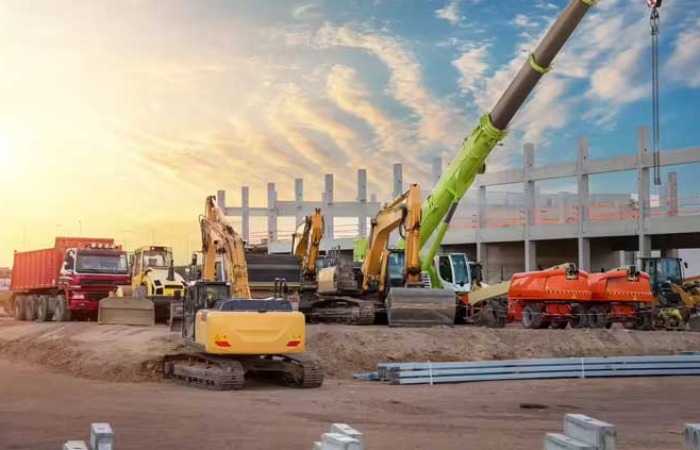
Indian CE Industry FY26: Demonstrating Resilience
The Indian Construction Equipment Manufacturers Association (ICEMA) announced that the Indian construction equipment (CE) industry witnessed a decline of approximately 2 per cent in total equipment sales during FY 2025-26, with overall sales declining to 1,36,995 from 1,40,191 units in FY25. Despite temporary domestic market challenges linked to slower infrastructure execution and project delays, the industry remained resilient, supported by a robust 32 per cent surge in exports. India continues to remain the worlds third-largest construction equipment market, with the sector estimated at $10 billion in FY26 and projected to reach $14.76 billion by 2030 at a CAGR of 8.3 per cent.
Deepak Shetty, President, ICEMA and CEO & MD, JCB India, said: The marginal decline witnessed in FY26 must be viewed in the context of slower infrastructure execution on the ground rather than any structural weakness in the industry. While Government capex allocations continue to remain at historically high levels, delays in project execution, land acquisition challenges and slower disbursement cycles impacted equipment demand during the year. At the same time, the industry demonstrated resilience through a strong 32 per cent growth in exports, highlighting the growing global competitiveness of Indian-manufactured construction equipment. We remain confident about the industrys long-term growth trajectory driven by Indias continued infrastructure development focus.
Key performance highlights
- Total equipment sales: 1,36,995 units, reflecting an approximately 2 per cent decline over FY25
- Domestic demand (excluding non-OEM exports): Declined by approximately 7 per cent YoY across most equipment categories
- Exports: Registered a strong approximately 32 per cent growth, reaching record levels across major equipment categories
- Imports: Increased by approximately 17 per cent, mainly in earthmoving, material handling and concrete equipment
- Domestic manufacturing strength: Over 95 per cent of equipment sold in India continued to be manufactured domestically
Earthmoving equipment continued to dominate with about 71 per cent market share at 97,236 units (?2 per cent YoY). MHE recorded 15,290 units (?10 per cent YoY). Concrete equipment remained broadly stable at 14,486 units (+0.09 per cent YoY). Road CE posted positive growth of about 6.3 per cent to 7,445 units. Material processing equipment registered modest growth of 1.2 per cent at 2,538 units.
Ramesh Palagiri, President Designate, ICEMA & MD and CEO, Wirtgen India, said: The Indian CE industry continues to remain resilient despite temporary challenges linked to slower project execution and infrastructure implementation gaps. Industrys long-term fundamentals remain strong, supported by government focus on infrastructure development and manufacturing growth. Timely project awards, faster execution on ground and improved implementation efficiency will play a critical role in sustaining industry momentum going forward.
Domestic demand was impacted by several converging headwinds: National Highway construction activity fell to a seven-year low due to land acquisition delays and fewer project awards; Jal Jeevan Mission (JJM) implementation slowed with moderated fund disbursements; contractor payment delays compressed liquidity across the infrastructure ecosystem; the implementation of CEV Stage V emission norms from Jan 2025 raised equipment costs given the high financing dependence in the industry; and global commodity price inflation through rising crude oil and bitumen costs added further pressure in the latter part of FY26.
Shalabh Chaturvedi, Vice President, ICEMA and MD “ India & SAARC, CASE Construction Equipment India, said: FY26 has been a year of temporary moderation for the CE industry due to slower project execution and infrastructure momentum across certain sectors. The slowdown in highway construction activity, delays in project awards and moderation in JJM implementation impacted equipment demand during the year. However, the industry continues to remain resilient and optimistic about long-term opportunities. Indias infrastructure growth story remains strong and timely execution of projects, faster implementation on ground and improved liquidity support for contractors will be critical in restoring growth momentum for the sector.
Despite domestic challenges, exports emerged as a major growth driver, registering an impressive 32 per cent increase over FY25 across most equipment categories. This reflects growing global acceptance of Indian-manufactured CE due to improved quality standards, competitive pricing and enhanced manufacturing capabilities. The implementation of CEV Stage V emission norms has further aligned India with global regulatory standards, strengthening export opportunities in developed markets.
Vivek Hajela, Convener, ICEMA Industry Analysis & Insights Panel and Exec VP & Head Construction & Mining Machinery Business, L&T, said: The strong export growth witnessed in FY26 reflects the increasing competitiveness and acceptance of Indian construction equipment across global markets. The industrys fundamentals remain strong and the current slowdown is largely linked to execution-related challenges rather than demand potential. As infrastructure implementation accelerates, project execution improves, and project awarding activity gathers pace, the industry is well-positioned to return to a stronger growth trajectory.
The Union Budget 2026“27 marks a transformational milestone for the industry. The Governments announcement of a dedicated incentive scheme for the Construction and Infrastructure Equipment (CIE) sector fulfils a long-standing ICEMA demand, supporting high-technology manufacturing, automation and precision engineering. The scheme will drive localisation of critical components- including hydraulics, engines, transmission systems and undercarriage parts reducing import dependence, lowering project costs and generating large-scale employment. The increase in public capex to Rs 12.2 lakh crore in FY27, along with dedicated freight corridors, seven high-speed rail corridors, 20 new National Waterways and the Coastal Cargo Promotion Scheme, will accelerate infrastructure execution and directly benefit equipment demand across categories.
The Indian CE industry remains optimistic about long-term growth prospects driven by continued investments in roads, railways, mining, urban infrastructure, housing and rural development. While FY26 witnessed temporary moderation due to execution-related challenges, the industry expects demand recovery as project implementation improves and infrastructure activity accelerates. The strong export foundation, robust domestic manufacturing ecosystem and continued Government emphasis on infrastructure development are expected to support sustained industry growth in the coming years.
 A-303, Navbharat
Estates,
Zakaria Bunder Road,
Sewri (West), Mumbai - 400 015,
Maharashtra, India
A-303, Navbharat
Estates,
Zakaria Bunder Road,
Sewri (West), Mumbai - 400 015,
Maharashtra, India +91-22-24193000
 Subscriber@ASAPPinfoGlobal.com