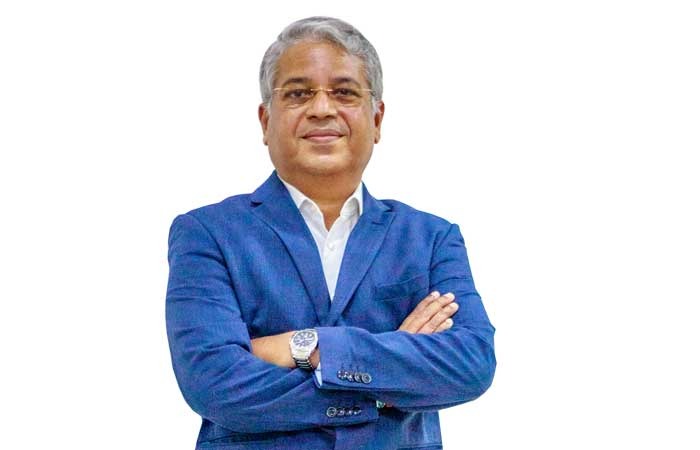
Road equipment is the engine of Vision 2047.'
VG Sakthikumar, Chairman & Managing Director, Schwing Stetter India, speaks on technologies such as telematics, machine control, automation, AI and connected job sites and how it is improving productivity, quality and project execution.
As India pursues its Vision 2047 infrastructure goals, what role do you see road construction equipment playing in transforming the country's road and highway network?
Road construction equipment is not merely a support tool it is the very engine of India's Vision 2047. India's national highway network has already grown from 91,000 km in 2014 to over 1.46 lakh km today, and this is just the beginning. To achieve the ambitious targets under Bharatmala Pariyojana and PM Gati Shakti, equipment must evolve in both scale and intelligence.
At Schwing Stetter India, we see our role as a complete solutions provider from concrete production and transportation to placement and recycling. The construction equipment industry, through large-scale localised manufacturing, reduces import dependence and accelerates delivery timelines. By championing automated, high-capacity, and sustainable solutions, we directly translate government infrastructure investment into physical, durable road infrastructure kilometre by kilometre, project by project.
What are the key trends currently shaping demand for road construction equipment in India, and how do you expect these trends to evolve over the next decade?
India's road construction equipment market is currently in a high-growth phase, projected to reach $9.24 billion in 2026. Several powerful trends are shaping this demand rapid urbanisation driving need for high-capacity equipment, the shift from CEV Stage III to CEV Stage V emission norms significantly influencing equipment design and procurement decisions, and sustained government allocation of over Rs 3 lakh crore to the Ministry of Road Transport and Highways.
Contractors today want machines that are faster, fuel-efficient, and digitally connected. Over the next decade, demand will decisively shift toward electric and hybrid powertrains, IoT-enabled equipment, and decentralised production solutions. Self-loading mixers functioning as mobile, automated mini-batching plants will become increasingly critical for reaching tier-2, tier-3, and remote project locations efficiently.
How are technologies such as telematics, machine control, automation, AI and connected job sites improving productivity, quality and project execution?
Schwing Stetter India has moved decisively beyond conventional automation into AI and ML-enabled intelligent systems. At the core is our SCHWING Telematics platform, integrated with Trackunit®, which captures real-time CAN-bus data including fuel consumption, hydraulic pressures, and concrete feed quantities enabling AI to predict maintenance needs before failures occur. This proactive approach reduces unplanned job site downtime by 20 to 30 percent. Our Intelligent & Safe Operations Hub provides connected fleet visibility, live dashboards, and complete operational traceability across project sites.
Automated SCADA systems in batching plants bridge field data with enterprise ERPs, ensuring precise mixing and streamlined timelines. Additionally, AI-driven virtual simulators for operator training significantly reduce site accidents, building a safer, smarter, and more productive construction ecosystem across every project.
Sustainability is becoming increasingly important in infrastructure development. How are equipment manufacturers supporting greener road construction through technology, fuel efficiency and recycling solutions?
Sustainability is not an afterthought at Schwing Stetter India it is engineered into every product. We launched India's first fully electric transit mixers and hybrid boom pumps, with our S36X hybrid boom pump switching seamlessly to on-site electric grid power, delivering up to 15 per cent energy savings. Our Concrete Recycling Plants (RA Series) separate aggregates down to 0.2 mm and reclaim slurry water from unused wet concrete for reuse in subsequent batching dramatically reducing material waste on project sites.
Our entire self-loading mixer fleet has transitioned to CEV Stage V compliant, low-emission engines. Furthermore, our global manufacturing hub at Cheyyar, Tamil Nadu operates on a 1 MW solar power system, reflecting our commitment to green operations not just in our products, but across our entire manufacturing ecosystem.
Contractors today are under pressure to deliver projects faster while controlling costs. What innovations are helping improve equipment uptime, operational efficiency and lifecycle economics?
Contractors today face the dual pressure of aggressive timelines and tight budgets and Schwing Stetter India addresses both frontally. Through our SCHWING Telematics platform and AI-powered predictive maintenance, unplanned equipment downtime is reduced by up to 30 percent, ensuring project schedules stay intact. Our innovative FBP Truck Mixer Pump combines transport, mixing, and pumping functions on a single chassis, significantly reducing fleet complexity and operational costs on site. AI-optimised power management in hybrid models reduces energy consumption by up to 15 per cent. Perhaps most compellingly, through fuel savings and precision cement dosing enabled by AI, certain machines return 40 percent of their initial investment to the owner within just two years making the business case for technology adoption both clear and compelling for contractors across India.
Looking ahead to 2047, what will the ideal road construction project site look like, and how will road equipment evolve to meet future infrastructure requirements?
By 2047, the ideal road construction project site will be a fully connected, autonomous, and zero-emission ecosystem. Equipment will operate through AI-driven digital twins, with machines communicating in real-time to synchronise paving, compaction, mixing, and material supply without human intervention or idle time. Powertrains will be fully electric or hydrogen-based, eliminating on-site emissions entirely.
Operators will manage entire fleets remotely through intelligent control hubs, with predictive AI flagging risks before they materialise. At Schwing Stetter India, we are already building toward this future through our Global Capability Centre at Cheyyar undertaking product design for global markets, our 15 filed patents, and our Industry 4.0 manufacturing. India is asking for taller, faster, and greener infrastructure and we are answering that call.
 A-303, Navbharat
Estates,
Zakaria Bunder Road,
Sewri (West), Mumbai - 400 015,
Maharashtra, India
A-303, Navbharat
Estates,
Zakaria Bunder Road,
Sewri (West), Mumbai - 400 015,
Maharashtra, India +91-22-24193000
 Subscriber@ASAPPinfoGlobal.com