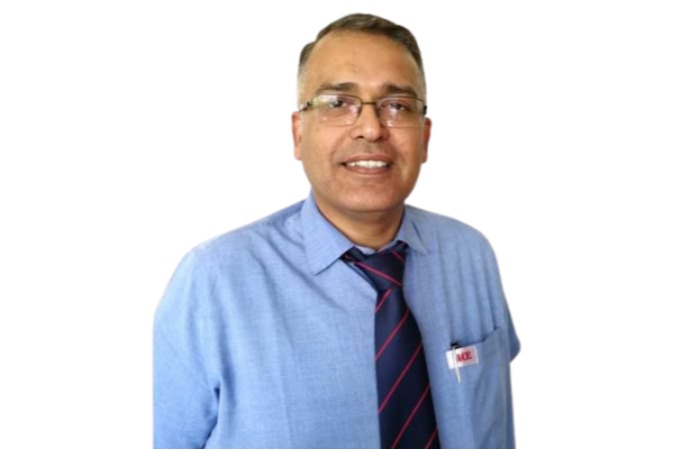
The technology gap between Western and Indian equipment has narrowed
What were the key products showcased by ACE at Bauma CONEXPO India 2026?
This time, we kept our display relatively compact and showcased three to four products. One of the key highlights was our new 6010 tower crane, which has a 60-m jib and can lift 1 tonne at 60 m.
We also displayed our aerial work platforms (AWPs), including an articulated boom lift and a scissor lift, along with a backhoe loader. Except for the tower crane, most of these products are already available in the market.
What key market trends are you witnessing, and how are they influencing your product strategy?
Over the past three to five years, the emphasis on safety in India has increased significantly. In terms of features, Indian equipment has already progressed considerably, but safety is now receiving much greater attention.
This is also driving the growing importance of aerial work platforms. Earlier, people were often taken to elevated work areas through different means, but the industry is now increasingly focused on providing safer access. As safety awareness improves, products such as AWPs are becoming more popular.
How is automation improving safety in tower crane operations?
Earlier, anti-collision systems in tower cranes were relatively rare and were generally seen only at select prestigious project sites. Today, they are becoming increasingly common, particularly at sites where multiple tower cranes are operating simultaneously.
Most of the other safety features were already available, but the adoption of anti-collision systems has increased substantially. On major project sites with multiple cranes, such systems are now becoming an important part of operations.
How is ACE progressing towards cleaner technologies and electrification?
We have already started seeing a shift in forklifts, where the market is increasingly moving from diesel-powered machines towards battery-powered equipment.
We have developed a battery-powered crane model as well. However, one of the challenges is that the regulations required for registering such equipment are yet to be formulated. Since our cranes operate on roads and need to be registered, this remains a constraint.
Technologies are continuing to evolve, and electrification will happen in construction equipment sooner or later. This is inevitable. Just three or four years ago, electric solutions were hardly seen in heavy equipment or commercial vehicles, whereas today several manufacturers are introducing them.
The government needs to formulate the necessary parameters so that these machines can be registered. Once that happens, adoption can accelerate. With diesel prices also remaining a major operating-cost consideration, the transition towards electrification is likely to gain further momentum.
Where do you see the biggest growth opportunities for ACE?
Earlier, our business was largely focused on material handling. We have now expanded into man handling as well. Products such as AWPs are designed to take people to elevated work areas safely. Similarly, in the tower crane segment, we have also started working on passenger lifts.
Beyond this, exports and defense are two areas where we see significant opportunities for growth.
Which international markets offer the strongest opportunities for Indian construction equipment manufacturers?
Historically, Indian construction equipment manufacturers primarily looked at Africa when expanding internationally. Some of the more aggressive companies also ventured into Latin American markets.
I believe the time has now come for Indian manufacturers to target markets such as Europe, North America, Australia and even Japan. The technology gap between Western and Indian equipment has narrowed considerably, and Indian products are increasingly comparable with global offerings.
Over the next four to five years, we are likely to see more Indian companies entering these developed markets. India also has a cost advantage in manufacturing compared with many Western economies. China benefited from this advantage for several years, and India now has an opportunity to build on its own manufacturing capabilities.
Over the next five to ten years, I expect significantly more manufacturing activity to take place in India. Western, Japanese and Korean companies are also evaluating alternatives to manufacturing exclusively in China, and India can emerge as an important manufacturing base.
India already has a large construction equipment market, which provides manufacturers with a strong domestic base while also allowing them to produce competitively for international markets.
 A-303, Navbharat
Estates,
Zakaria Bunder Road,
Sewri (West), Mumbai - 400 015,
Maharashtra, India
A-303, Navbharat
Estates,
Zakaria Bunder Road,
Sewri (West), Mumbai - 400 015,
Maharashtra, India +91-22-24193000
 Subscriber@ASAPPinfoGlobal.com