The Confidence Roadmap
India’s road-building story is one of the country’s most visible infrastructure successes. A sector that was constructing around 12 km of roads a day a decade ago has moved towards nearly 34 km a day, backed by an ambitious project pipeline and strong government intent. Yet, as the sector enters a more complex phase—with larger highways, tunnels, bridges and sophisticated transportation assets—the question is no longer simply how fast India can build. It is how confidently it can build.
The distinction matters. A road may be awarded quickly, but delays in land acquisition, utilities, payments, geological surprises or stakeholder approvals can quickly undermine the economics of a project. A tunnel may be designed to meet a deadline, but inadequate investigations can leave contractors facing conditions that were never priced into the contract. An asset may be built with a promised 50- or 100-year life, but without regular inspection and maintenance, that promise remains largely theoretical.
India’s next infrastructure challenge, therefore, is less about finding ambition and more about building trust into the system. That means giving contractors confidence that risks will not be disproportionately transferred to them, consultants the time to produce robust designs, investors the visibility to deploy patient capital, and asset owners the discipline to maintain infrastructure long after its inauguration.
When risk becomes the roadblock
Few parts of infrastructure demonstrate the problem better than tunnelling. As India pushes deeper into difficult terrain and increasingly turns underground to solve connectivity challenges, conventional contracting models are being tested by geological realities.
Col Parikshit Mehra, Secretary, Government of Telangana, has seen these challenges first-hand through projects including the Atal Tunnel, Sela Tunnel and Srisailam Left Bank Canal project. Underground construction, he argues, cannot be treated like a conventional EPC job where every variable is assumed to be known at the tendering stage.
“The EPC contract does not do justice to underground works because there are so many unknowns when you're working in the underground space,” he said.
The answer, in his view, lies in contracts that recognise uncertainty rather than attempt to eliminate it on paper. He advocated incorporating the principles of the FIDIC Emerald Book, including geotechnical baselines and mechanisms for time-related costs and unforeseen ground conditions. “If you can get those principles in, with geotechnical baselines, I think financiers would like to finance these projects, contractors would not mind because risk would be shared,” Mehra said.
That idea of shared risk emerged as one of the strongest themes of the discussion. It is also at the heart of the industry’s wider concerns over contracting.
Prashant Kapila, President, Consulting Engineers Association of India, believes the current system often places too much responsibility on the contractor while offering insufficient certainty in return. “The current works contract is skewed. It’s very unfair on the contractors. The risk is entirely put on their end,” he said.
The implications go beyond contractors. If risks are poorly defined, financiers become cautious, contractors price uncertainty into bids, disputes increase and projects ultimately become more expensive or take longer to complete.
For Kapila, wider adoption of internationally recognised standard contracts such as FIDIC could provide a more credible foundation for India’s infrastructure ambitions.
Much of the risk that surfaces during construction, however, originates much earlier—in the DPR. In complex projects, particularly tunnels, a DPR cannot simply be a document prepared to meet a tender deadline. It needs to be an investigation into what lies beneath the proposed project and what could potentially go wrong.
Mehra believes this requires a fundamental change in project planning. “We have to decouple our planning from execution. Especially in long tunnels, our DPR should be five years ahead of the execution plan,” he said.
The argument is not about delaying infrastructure. It is about spending more time upfront to avoid losing far more time later.
His experience on the Nathpa Jhakri project illustrates the point. One tunnel approach encountered temperatures of around 53-54°C, a condition that had not been reflected in the DPR. At another location, ground conditions were so weak that a planned adit could not be used and a new one had to be opened.
Such experiences demonstrate why complex infrastructure cannot be planned purely from drawings and desktop studies.
Kapila sees the same problem from the consulting side. India has the technical talent to produce high-quality, technology-enabled DPRs, but procurement practices often fail to provide consultants with the time or incentives to do so.
“Are the consultants in the country capable to do this? Definitely. Are we giving them adequate time? No. Is our expectation from them realistic? No,” he said.
The future DPR, he argues, should be dynamic, data-driven and increasingly based on GIS and digital-twin technologies. But that transformation also requires a shift away from selecting consultants purely on the lowest price.
His larger concern is the declining attractiveness of engineering itself. “We need to make engineering sexy again,” Kapila said, arguing that the profession must regain its place at the centre of infrastructure decision-making. He also reiterated his call for an Engineer’s Bill, pointing out that while several professions have dedicated regulatory frameworks, engineering does not have an equivalent overarching mechanism.
Tech needs to see around the corner
Better project preparation must be complemented by better execution. Here, technology is rapidly changing the construction landscape—but only if companies use it to anticipate problems rather than simply document them.
Arghya Chattopadhyay, Vice President and Head – Roads, Runways Business Unit, Transportation Infrastructure Business, L&T, sees risk management as one of the defining challenges for large contractors.
“Identifying a risk and mitigating it in the correct time—that is a major issue for us also,” he said. The risk profile of construction has changed. Land acquisition, utility shifting, skilled manpower shortages and stakeholder expectations are now common challenges, irrespective of the size of the contractor.
Technology is already being deployed through digital project controls, BIM-based coordination, drones and AI analytics. But Chattopadhyay cautioned that simply generating more information does not necessarily improve decision-making.
“Sometimes it remains just a report. Whatever has happened yesterday comes in a beautiful Excel sheet giving you data. I think that is not the real utilisation of the technology,” he said.
The real opportunity lies in moving from hindsight to foresight—using technology to predict delays, identify emerging risks and make organisations more agile before problems become expensive.
That same philosophy needs to extend beyond construction to the entire life of an asset.
For Rajiv Sethi, Founder & MD, Gemini Power Hydraulics, India already possesses much of the equipment and capability required for sophisticated inspection and maintenance. What is missing is consistent implementation. “The industry is ready. The government has to make stricter norms for making things happen,” he said.
The gap between what a tender specifies and what is actually enforced on the ground can be significant, particularly in inspection and safety.
Sethi believes India needs to move away from the familiar cycle in which an accident triggers intense scrutiny, followed by a gradual return to business as usual.
“The thing has to move from knee-jerk to predictive, regular review, maintenance,” he said. That shift could become increasingly important as India's road network expands. Building an asset for a 50-, 80- or 100-year life means little unless inspection, maintenance and rehabilitation are treated as integral parts of that lifecycle.
The technology exists. Specialist inspection equipment exists. The industry has the capability. What is required is a system that makes their use routine rather than reactive.
Capital is waiting for the right assets
If confidence is rebuilt on the execution side, the investment community is ready to participate.
Manish Chitkara, CEO & Whole-time Director, Sekura Roads, rejected the notion that India faces a fundamental shortage of infrastructure capital.
“Today the equity or the money is not a problem,” he said. The sector has evolved considerably through EPC, BOT, HAM and other models, while global institutional investors, domestic institutions and family offices have developed a greater appetite for Indian infrastructure. The challenge is increasingly the quality and investability of assets.
Investors conduct extensive technical, legal, financial, tax and ESG due diligence before acquiring road assets. What looks attractive at the project level can appear very different after these risks are factored into valuation.
The proliferation of smaller HAM projects has also created concerns around scale and quality. Chitkara believes larger packages could attract stronger players and create better assets.
The objective is not simply to reduce the cost of construction. It is to create assets that remain investable throughout their lifecycle. That requires another ingredient: predictability.
“If you are announcing HAM assets or BOT toll assets or TOT model, any other model, you need to give your pipeline for the next three to four years and make sure you follow them,” Chitkara said.
For investors and contractors alike, a predictable pipeline enables long-term decisions on capital, manpower, equipment and capacity.
The industry’s confidence challenge ultimately comes down to how India chooses to procure and deliver infrastructure. The panel's concerns converged around a system where the lowest price can sometimes become the dominant consideration, even when the cost of poor quality, delays or inadequate maintenance is far greater.
Kapila was unequivocal in his prescription: “Move away from L1, adopt QCBS or QBS for works and consultants.”
Chattopadhyay added another dimension—the need to build a deeper ecosystem of capable contractors and specialised vendors. India cannot depend on a handful of large companies to execute an infrastructure programme of this scale.
“One or two L&Ts will not be able to build this country. We need a number of L&Ts and many, many mid-level construction companies,” he said.
That ecosystem also needs healthy cash flows. Even large contractors face difficulties when certifications or payments are delayed, while the impact on smaller companies can be existential.
“Without money flow, construction will not move. You cannot expect before-time or on-time delivery unless you pay contractors sufficiently,” Chattopadhyay said.
The message is ultimately straightforward. Infrastructure cannot be built sustainably when risk is simply pushed down the chain. India has the ambition, the capital, the technology and the construction capability to build the next generation of roads and highways. What it needs now is a system that allows these strengths to work together.
Better contracts can distribute risk. Better DPRs can reduce uncertainty. Technology can predict problems. Professional engineering can strengthen decision-making. Inspection can protect assets after construction. A predictable pipeline can unlock capital. And a stronger contractor ecosystem can spread capability across the industry.
The next chapter of India’s roads story, therefore, will not be defined merely by kilometres built.
It will be defined by whether every stakeholder—from the engineer and contractor to the investor and asset owner—has enough confidence in the system to take the next project forward.
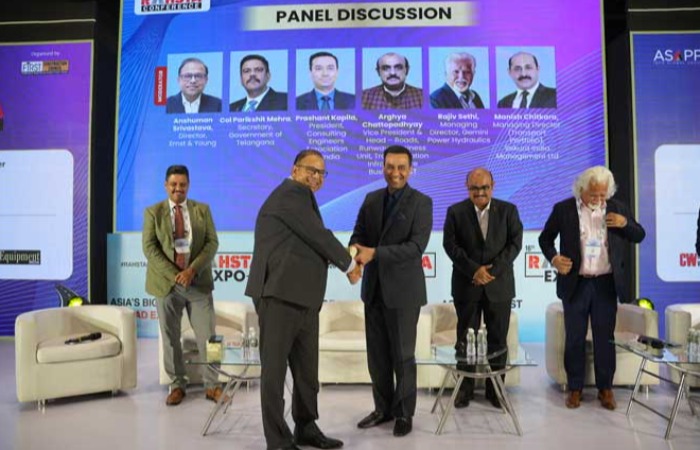
This feature is based on the panel discussion titled “Rebuilding Confidence in India’s Roads & Highways Sector”, held at RAHSTA 2026 on July 9, 2026.
 A-303, Navbharat
Estates,
Zakaria Bunder Road,
Sewri (West), Mumbai - 400 015,
Maharashtra, India
A-303, Navbharat
Estates,
Zakaria Bunder Road,
Sewri (West), Mumbai - 400 015,
Maharashtra, India +91-22-24193000
 Subscriber@ASAPPinfoGlobal.com